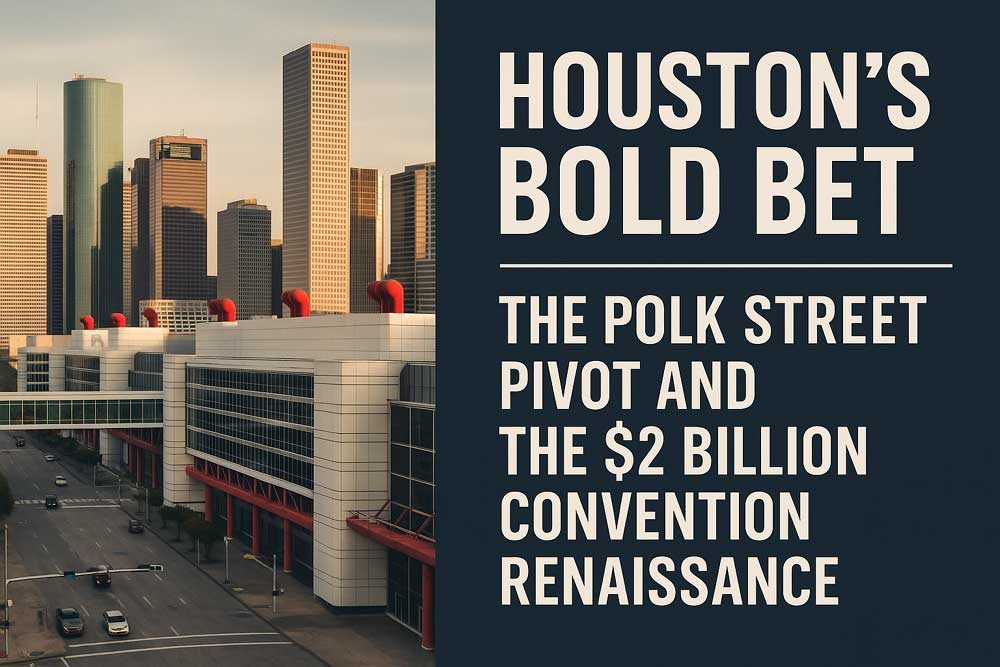
In the heart of Houston, where the humid Gulf breeze mingles with the roar of engines and the hum of half-a-million daily commuters, lies a stretch of roadway that has quietly anchored the city’s pulse for decades. Polk Street, that unassuming artery slicing through downtown’s eastern flank, has long served as more than mere pavement—it’s a lifeline, a conduit for families shuttling to soccer games at the Toyota Center, cyclists weaving toward Discovery Green, and East End workers dodging the snarl of I-45 to clock in at bustling cafes. But as of October 15, 2025, with a decisive 14-1 vote from the Houston City Council, Polk Street’s fate was sealed: a permanent closure, sacrificed on the altar of progress for the George R. Brown Convention Center’s audacious $2 billion expansion.
This isn’t just about bricking up a two-block segment from St. Emanuel to Avenida de las Americas; it’s a seismic shift in how Houston envisions its core. The expansion, spearheaded by Houston First Corporation, promises to catapult the city into the league of global event powerhouses, priming it for the 2026 FIFA World Cup and the 2028 Republican National Convention. Yet, beneath the glossy renderings of sun-dappled plazas and the largest ballroom in Texas, simmers a deeper narrative: one of tension between economic alchemy and equitable access, where the thrill of reinvention clashes with the fear of erasure. Picture a metropolis that has always chased the horizon—oil booms, space shuttles, skyline silhouettes etched against prairie sunsets—now pausing to ask: Who gets to cross this new threshold, and at what cost?
As construction cranes pierce the skyline and TxDOT’s North Houston Highway Improvement Project (NHHIP) reshapes I-45 into a subterranean beast, Houston stands at a pivotal juncture. This post delves into the marrow of the Polk Street saga, unpacking the expansion’s grand blueprint, the voices rising in protest, and the potential ripple effects on a city that thrives on reinvention. It’s a story of asphalt dreams deferred, community grit unyielding, and a downtown poised for either triumphant rebirth or bittersweet fragmentation. In the words of East End advocate Marcie Hysinger, co-founder of the grassroots People for Polk coalition, “We’re not against growth; we’re against growth that grows over us.” Let’s trace the fault lines.
The Evolution of a Giant: From Humble Halls to Houston’s Event Empire
To grasp the stakes of today’s expansion, one must rewind to 1987, when the George R. Brown Convention Center (GRB) first unfurled its sails along the eastern edge of downtown. Named for the visionary engineer and philanthropist George Rufus Brown—who donated six of the 11 blocks needed for its footprint—the GRB was born amid Houston’s post-oil bust renaissance, a 1.8-million-square-foot behemoth designed to lure conventions fleeing the Rust Belt for the Sun Belt’s embrace. Its debut coincided with the city’s ascendant swagger: Enron’s towers gleamed, the Astrodome echoed with Astros cheers, and the GRB hosted its inaugural event, the American Society of Association Executives’ annual meeting, signaling Houston’s intent to play in the big leagues.
But size alone doesn’t sustain empires. By the early 2000s, as Super Bowl XXXVIII loomed, the GRB swelled nearly twofold, gobbling up 800,000 square feet in a frenzy of steel and glass. This 2003 expansion birthed three cavernous exhibit halls and a warren of meeting rooms, transforming the center into a versatile colossus capable of juggling trade shows, galas, and gearhead expos. Fast-forward to 2016, and another metamorphosis: a $120 million renovation flung open the GRB’s southern facade to Discovery Green, birthing the Avenida Houston Plaza—a sunlit ribbon of terrazzo and palms that stitched the convention hall to the urban park’s verdant allure. Suddenly, conventioneers could stroll from keynote speeches to kite-flying picnics, blurring the lines between business and bayou bliss.
Enter 2025, and the GRB’s latest avatar: the Convention District Transformation, a 30-year odyssey budgeted at $2 billion, with Phase One alone clocking in at a staggering 700,000 square feet of new real estate dubbed GRB Houston South. Envisioned by a dream team—architects Populous, developers Hines, landscape wizards Jacobs, and builders Gilbane-Flintco—this southern appendage isn’t mere addition; it’s reinvention incarnate. At its core: two state-of-the-art exhibition halls, flexible as a gymnast’s spine, primed for everything from drone swarms to diamond auctions. Crowning the edifice? The Lone Star State’s grandest ballroom, a 50,000-square-foot marvel with ceilings soaring like a cathedral nave, lit by chandeliers that could double as modern art. Ground-level activations buzz with retail pods and eateries—think farm-to-table taquerias nodding to East End roots, or pop-up bars slinging craft IPAs infused with prickly pear.
But the true sorcery lies in connectivity. A 100,000-square-foot pedestrian plaza arcs like a welcoming arm toward the Toyota Center, erasing the vehicular moat that once divided convention-goers from Rockets fans. Slated for a living roof inspired by native prairies—slatted wood evoking buffalo grass, laced with low-carbon solar panels—this green crown promises not just shade but sustainability, capturing rainwater for irrigation and slashing the carbon footprint of events that draw 1.5 million visitors annually. Houston First’s CEO, Michael Heckman, paints it poetically: “We’re not building a building; we’re weaving a district—a nexus where commerce courts culture, and every block breathes with possibility.”
Funding this fantasia? A clever sleight-of-hand via Senate Bill 1057, which funnels incremental hotel occupancy taxes into the coffers without pinching taxpayers’ pockets. Groundbreaking looms for early 2026, with Phase One eyeing completion by summer 2028—just in time for the GOP’s grand gathering. Yet, as blueprints dazzle, shadows lengthen: the expansion’s southern thrust demands land, and Polk Street, that humble thoroughfare, stands in the way.
The Polk Predicament: From Vital Vein to Vanishing Act
Polk Street isn’t Houston’s flashiest boulevard—no neon marquees or haute couture haunts here. Stretching east-west like a pragmatic spine, it hums with the rhythm of real life: METRO buses 40 and 41 ferrying 30,000 riders weekly to jobs and joys alike; cyclists in high-comfort lanes—upgraded just last year as part of the Third Ward Bikeway Network—gliding toward Emancipation Avenue; families in lowriders idling at lights, windows down to catch the sizzle of nearby food trucks. For East End denizens, many of whom trace roots to the neighborhood’s Mexican-American enclave founded in the 1880s, Polk is the uncelebrated hero bridging their vibrant barrio—alive with murals of Aztec warriors and taquerias dishing machacado—to downtown’s glittering grid.
That bridge buckles under the weight of dual juggernauts: the GRB’s sprawl and TxDOT’s NHHIP, a $7.6 billion behemoth set to depress I-45 below grade and realign it with I-69/US-59, effectively severing Polk’s midsection by 2030. Houston First, eyeing contiguity for its southern wing, seeks to preemptively “abandon” an extra two blocks—from Hamilton to Avenida de las Americas—transferring them to its stewardship alongside snippets of Chenevert, Jackson, and Bell streets. The rationale? Seamless event flow: no pesky traffic choking the exodus from a sold-out expo, no curbs cramping outdoor activations. “Polk’s closure creates breathing room for the district’s magic,” Heckman asserts, envisioning greenspaces where semis once idled.
Yet, to East Enders, this “magic” feels like amputation. Signs sprouted on February 1, 2025, like digital harbingers: “Abandonment Requested,” they blared, igniting a firestorm. Gabby Gilmore, a 30-year-old graphic designer and People for Polk co-founder, recalls the shock: “We woke up to our street on the chopping block, no heads-up, no dialogue. It’s like the city planned a party and forgot to invite the neighbors.” Protests swelled outside E.B. Cape Learning Center on March 18, placards aloft: “Save Polk! Equity Over Expansion!” Inside, town halls crackled with fury—residents grilling officials on appraisals unfinished, timelines vaporous, and mitigations that smacked of afterthought.
The math underscores the menace. A Transcend Engineers traffic study, commissioned by Houston First, claims “minimal delays” at 50 intersections post-closure, with Leeland Street’s conversion to two-way traffic absorbing the load. Critics scoff: Leeland, already a one-way cog in a downtown pair with Bell, bottlenecks at rail crossings and floods during storms. “It’s lipstick on a bulldozer,” quips Council Member Julian Ramirez, whose district hugs the East End. “We’re trading a multi-modal lifeline for a pedestrian promenade that won’t open till 2038.” Buses reroute, adding 10-15 minutes to commutes; cyclists lose their sole protected east-west path; businesses like The Rustic bar, eyeing relocation, fret over foot traffic evaporation.
This isn’t hyperbole—it’s history echoing. The East End, once a mosaic of shotgun houses and lemon groves, has weathered waves of “revitalization” that cleaved it from the core: I-45’s 1950s gash, BBVA Stadium’s 2012 footprint, even Minute Maid Park’s sprawl. “Ghettoized,” laments resident Ian Hlavacek, a software engineer who pedals Polk daily. “Every boom leaves us behind the barricades, promising jobs that go to suburbanites and parks we can’t reach without a detour.” People for Polk, a scrappy all-volunteer troupe, unearthed precedents abroad—Dallas’s convention redo wove in community threads, Vegas preserved arterials amid glitz—begging the question: Why can’t Houston?
The October 15 vote crystallized the chasm. Mayor John Whitmire, a Polk proponent, waved off dissent as “disruptors from afar,” touting a 10-20-year vista of downtown bounty. Edward Pollard cast the lone nay, District I’s Joaquin Martinez threading a memorandum for mitigation studies. Delay tactics—a week-long postponement on October 8—bought breaths, but the gavel fell. Now, with closure slated for late October, the onus shifts: Can Houston First deliver on vows of “restitching” via freeway caps and promenades, or will Polk’s ghost haunt the district’s gleam?
Economic Elixir or Equity Eclipse? The Dollars and Divides
Proponents brand the expansion a Midas touch. Hunden Partners’ August 2025 analysis forecasts $20 billion in spending over 30 years, a 62% event uptick, and “dark days” slashed by 66%—those idle slots when the GRB slumbers, costing millions in lost bookings. Houston First eyes 30% annual event growth, luring titans like Comic-Con or CES that Dallas and Austin covet. “This is our Super Bowl multiplier on steroids,” Heckman beams, citing 2026 World Cup prep and 2028 RNC as launchpads. Jobs bloom—construction gigs now, hospitality hires later—while the district’s alchemy spins retail gold: ground-floor shops channeling East End flair, from artisanal tortillerias to VR lounges.
Yet, skeptics spy fool’s gold. People for Polk’s op-ed salvo in the Houston Chronicle skewers the math: Taxes from East End pockets fund a playground for transients, with scant trickle-down to locals. “Billions for ballrooms, but our potholes persist,” gripes Gilmore, highlighting NHHIP’s synergies as a double whammy—five to six years of Polk severance during highway digs, U-turn detours via Hamilton extensions as flimsy fixes. Equity audits lag; minority-owned businesses, backbone of the East End, brace for displacement a la Rustic’s plight.
Broader strokes reveal fault lines. Houston’s convention chase mirrors national tides—cities like Philly and Orlando ballooned facilities sans street sacrifices, fostering inclusive growth. Here, the plaza’s prairie-inspired ethos—rainwater harvesting, solar sails—whispers green promise, but without robust transit ties (that east-west light rail remains a gleam in METRO’s eye), it risks elitist enclave: walkable for well-heeled visitors, labyrinthine for low-income riders. Whitmire counters with Leeland’s two-way pledge, but advocates demand more: dedicated bus lanes, bike underpasses, community benefit pacts mandating local hires.
In this ledger, Polk embodies the paradox: a $2 billion boon that could eclipse if unchecked, or elevate if woven with equity’s thread.
Voices from the Divide: Protests, Pledges, and the Path Unpaved
The human tapestry of this tumult unfurls in raw vignettes. At July 1’s town hall, Jennifer Peek of Walter P. Moore unveiled traffic models to a room thick with skepticism—buttons emblazoned “People for Polk” pinned like badges of defiance. Hysinger, 56, a retired teacher whose abuelo peddled produce on Polk in the ’50s, choked back tears: “This street carried my family’s story—weddings, wakes, Little League triumphs. Closing it erases us.” Across the aisle, Councilman Martinez, eyes steely, hammered for an MOU: “Growth yes, but not on the backs of those who’ve borne Houston’s burdens longest.”
Opposition swelled digitally too—petitions topping 5,000 signatures, X threads ablaze with #SavePolk renderings juxtaposing verdant plazas against gridlocked detours. State Sen. Molly Cook and Rep. Christina Morales amplified: “Pause for plans on mobility, safety, benefits—or risk a legacy of exclusion.” Even Mayor Pro Tem Martha Castex-Tatum, expansion ally, urged deeper outreach: “Hear the unheard; this district must uplift all.”
Houston First’s retort? A flurry of forums, sparse details notwithstanding. “We’re in lockstep with communities,” insists a spokesperson, touting NHHIP alignments like pedestrian bridges over the rerouted 45. But transparency tariffs linger—appraisals for acquired parcels pending, construction timelines hazy amid TxDOT’s 20-year odyssey. As shovels hover, the ballot box echoes: Pollard’s dissent a clarion, Martinez’s MOU a bridge—perhaps—to hybrid harmony.
Envisioning the Aftermath: A District Reborn, or a Scar Across the Soul?
Fast-forward to 2030: GRB Houston South hums, its halls teeming with World Cup fervor—Argentine fans spilling onto the plaza, samba syncing with Tejano beats from pop-up stages. The living roof, a verdant wave, hosts yoga dawn patrols; below, eateries pulse with fusion fare, drawing locals lured by subsidized shuttles. Leeland, two-way and tulip-lined, eases the ache, while NHHIP’s caps bloom into parks threading East End vines to downtown vines. $20 billion cascades: jobs at 15,000 annually, tax hauls funding Third Ward schools, a light rail whisking cyclists coast-to-coast. In this utopia, Polk’s ghost graces murals—a phoenix of resilience.
The dystopia? Gridlock gnaws: Buses lurch 20 minutes longer, East End isolation festers into resentment, businesses shutter as conventioneers cocoon in hotel bubbles. The plaza, pristine but patron-less midweek, symbolizes schism—progress for some, perdition for others. Displacement spikes rents 30%, echoing gentrification’s grim march from Midtown to EaDo.
The fulcrum? Adaptation. Houston First must honor Martinez’s MOU: phased appraisals, equity audits, co-design charettes where East Enders sketch their skyline share. TxDOT’s freeway caps—currently unfunded dreams—demand dollars, perhaps via federal grants tied to justice metrics. METRO accelerates rail; nonprofits incubate displaced vendors in plaza pods. Creativity calls: Polk-inspired art walks, virtual reality tours reclaiming the lost lane.
Conclusion: Houston’s Horizon—Inclusive or Infinite?
As October’s dust settles on Polk’s closure, Houston confronts its perennial riddle: How to harness ambition without hobbling the humble? The GRB expansion, with its ballroom bravado and plaza poetry, heralds a downtown dynamo—$20 billion in alchemy, events etching the city eternal. Yet, Polk’s paving-over whispers warning: Growth untethered from grace risks rending the social fabric Houston’s forebears wove—from Brown’s blocks to the East End’s resilient roots.
This isn’t endpoint; it’s ellipsis. With voices like Hysinger’s and Heckman’s in dialogue, mitigations mapped, and equity etched into every blueprint, the Convention District could transcend trope—becoming not just bigger, but better, a beacon where every Houstonian crosses freely. In a city that bends rivers and drills depths, why not bend toward belonging? The cranes rise; the choice lingers. Will Polk’s legacy be lament, or the spark for a more connected tomorrow? Houston, ever the shape-shifter, holds the trowel.