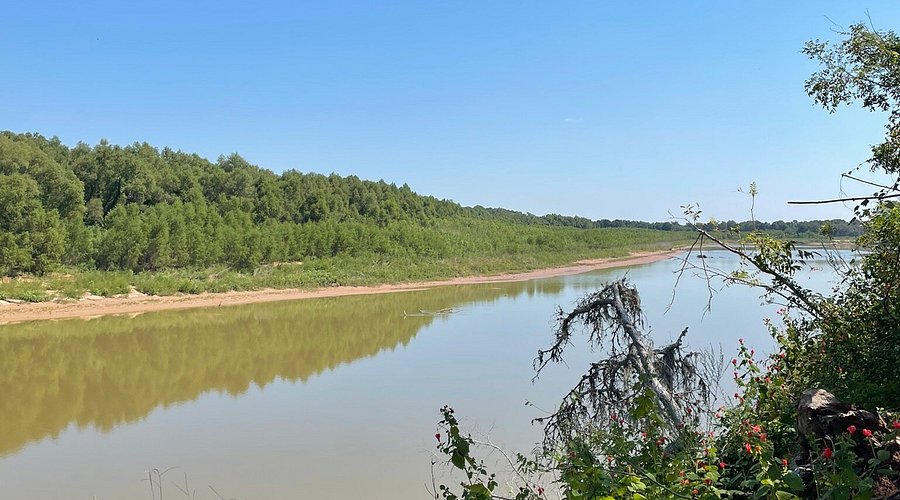
The dense pine forests of East Texas harbor countless secrets, but few locations capture the essence of the region quite like Stephen F. Austin State Park. Tucked away near the small community of San Felipe, this 664-acre sanctuary along the Brazos River represents far more than a recreational area—it stands as a living monument to Texas history, where the foundations of Anglo-American settlement in Texas were laid nearly two centuries ago.
A Landscape Shaped by History and Nature
The park’s terrain tells a story of geological patience and human ambition. Rolling hills covered in towering loblolly pines give way to bottomland hardwoods as the land slopes toward the Brazos River. The river itself, muddy and meandering, has been both highway and barrier throughout Texas history, its banks witnessing pivotal moments in the state’s transformation from Mexican territory to independent republic to American state.
Walking the trails here means traversing ground where empresario Stephen F. Austin once stood, contemplating the future of his colony. The park preserves the site of San Felipe de Austin, the colonial capital that served as the nerve center for Austin’s colonization efforts from 1823 to 1836. Though fire destroyed the original town during the Runaway Scrape as Texian forces retreated before Santa Anna’s advancing army, the land remembers.
Modern visitors find themselves surrounded by second-growth forest that has reclaimed the agricultural lands once cleared by Austin’s settlers. The park’s ecosystem represents the resilience of nature, where bottomland species like sycamore, elm, and cottonwood thrive in the flood-prone areas near the river, while upland zones support the characteristic pines and hardwoods of the Piney Woods region.
The Legacy of the Father of Texas
Understanding Stephen F. Austin State Park requires understanding the man for whom it’s named. Stephen Fuller Austin didn’t seek glory or conquest—he sought to build sustainable communities in a wilderness that challenged even the most determined pioneers. After inheriting his father Moses Austin’s empresario grant following Moses’s death in 1821, Stephen F. Austin spent the next fifteen years establishing what would become the most successful colonization venture in Mexican Texas.
The colony’s headquarters at San Felipe de Austin became a bustling frontier town, eventually growing to include stores, taverns, a cotton gin, and a printing press that produced Texas’s first newspaper. The town served as the de facto capital of Anglo Texas, hosting conventions, debates, and the passionate discussions that would eventually lead to the Texas Revolution.
Austin’s careful diplomacy with Mexican authorities, his meticulous record-keeping, and his genuine concern for his colonists’ welfare created a template for organized westward expansion that differed markedly from the chaotic land grabs occurring elsewhere on the frontier. He measured land, settled disputes, and created a system of governance that maintained order in a region far from established authority.
The park honors this complex legacy, acknowledging both Austin’s significant achievements and the complications inherent in any colonial enterprise. Interpretive displays explore the multiple perspectives of this historical moment—the Mexican government’s goals, the Anglo settlers’ motivations, and the impact on the indigenous populations whose lands were being transformed.
Exploring the Park’s Natural Features
The Brazos River forms the park’s southern boundary and serves as its defining natural feature. This ancient waterway has shaped the landscape through millennia of flooding, depositing rich alluvial soils that once made the area attractive to farmers. The river’s banks support a ribbon of riparian habitat that contrasts sharply with the upland pine forest, creating ecological diversity within a relatively compact area.
Hikers following the park’s trail system encounter this habitat diversity firsthand. The Main Loop Trail winds through pine-dominated uplands where filtered sunlight creates a cathedral-like atmosphere. The understory here remains relatively open, with ferns and shade-tolerant shrubs dotting the forest floor. Bird calls echo through the canopy as warblers, woodpeckers, and other species forage among the branches.
Descending toward the river, the forest character changes dramatically. The trail passes through transition zones where pines give way to deciduous species. During spring, wildflowers carpet these areas—bluebonnets, Indian paintbrush, and countless other species creating splashes of color against the green backdrop. The air grows heavier, more humid, carrying the earthy scent of river bottom and decaying vegetation.
The bottomland forest near the river represents one of Texas’s most threatened ecosystems. Development, agriculture, and flood control projects have eliminated much of the state’s original riparian woodland, making preserved areas like this increasingly valuable. The twisted branches of ancient cottonwoods and sycamores provide nesting sites for herons and egrets, while the dense understory offers cover for white-tailed deer, raccoons, and armadillos.
Recreational Opportunities Throughout the Seasons
Stephen F. Austin State Park adapts to the rhythms of the seasons, offering different experiences as the year progresses. Spring arrives early in East Texas, typically by late February or early March. The forest awakens gradually, with redbuds blooming first, their pink flowers creating a haze of color against still-bare branches. Soon after, dogwoods contribute their white blooms, and the wildflower display reaches its peak by April.
This season brings the most pleasant hiking conditions, with moderate temperatures and relatively low humidity. The park’s camping areas fill with families enjoying spring break, and the picnic grounds host weekend gatherings. Fishing enthusiasts crowd the banks of the Brazos, casting for catfish, bass, and the occasional gar.
Summer in East Texas demands respect. Temperatures regularly exceed ninety degrees, and humidity levels can make the air feel thick enough to cut. Yet the park doesn’t empty—it simply shifts to a different pace. Early morning hikers take advantage of cooler temperatures, and the swimming area becomes the park’s social center. Live oaks and other shade trees near the picnic pavilions provide relief, and smart visitors plan their outdoor activities around the heat.
The Brazos River becomes particularly important during summer months. Though swimming isn’t allowed in the river itself due to safety concerns, the park’s designated swimming area provides welcome relief. Families stake out spots near the water, and the laughter of children playing becomes the park’s soundtrack.
Autumn transforms the landscape gradually. Unlike the dramatic fall colors of more northern regions, East Texas experiences a subtler transition. Sweetgums and oaks slowly shift from green to gold and rust, with the change extending from October through November. The oppressive heat finally breaks, and the park experiences a second peak season as campers return to enjoy the comfortable weather.
Winter brings the quietest months. The park never truly goes dormant—pines remain green, and many oak species hold their leaves well into the cold season—but visitor numbers drop. This creates opportunities for those seeking solitude. Winter hikers often have the trails entirely to themselves, sharing the forest only with resident wildlife. The bare branches of deciduous trees reveal landscape features hidden during leafier seasons, and the absence of ground vegetation makes wildlife spotting easier.
The Archaeological Significance
Beneath the pine needles and leaf litter, the park protects archaeological resources that span thousands of years. Long before Stephen F. Austin arrived, indigenous peoples inhabited this region, leaving traces of their presence in the form of artifacts, hearth sites, and other evidence of daily life. The Brazos River corridor served as an important corridor for these earlier inhabitants, providing water, food, and transportation.
The San Felipe de Austin townsite itself represents a significant archaeological resource. Despite the fire that destroyed most above-ground structures in 1836, subsurface features remain. Archaeological investigations have uncovered building foundations, wells, trash pits, and other remnants of the colonial town. These findings provide tangible connections to Texas’s revolutionary period, offering insights that historical documents alone cannot provide.
The park works with professional archaeologists to protect these resources while making their significance accessible to visitors. Interpretive displays explain archaeological methods and findings, helping visitors understand how scientists reconstruct past lifeways from fragmentary evidence. This educational approach emphasizes that history exists not just in books but beneath our feet, preserved in layers of soil waiting to reveal their stories.
Wildlife and Ecological Communities
The park’s position at the interface between different ecological regions creates habitat diversity that supports varied wildlife populations. The East Texas Piney Woods region extends to the park’s edges, while Brazos River bottomlands create conditions more typical of coastal ecosystems. This mixing of habitats means species from different regions overlap here, increasing overall biodiversity.
White-tailed deer remain the park’s most visible large mammals. These adaptable animals thrive in the mix of forest and clearing that characterizes the park. Dawn and dusk bring the best viewing opportunities, as deer emerge from daytime bedding areas to feed in more open areas. Observant visitors might spot other mammals: eastern fox squirrels harvesting pine cones, eastern cottontails browsing at woodland edges, or raccoons prowling the river margins.
The bird life here reflects the region’s biodiversity. Year-round residents include Carolina chickadees, tufted titmice, and several woodpecker species ranging from the small downy woodpecker to the impressive pileated woodpecker with its distinctive call. The park lies within the Central Flyway, making it a stopover point for migrating species. Spring and fall bring waves of warblers, vireos, and other neotropical migrants passing through on their journeys between breeding and wintering grounds.
The Brazos River and associated wetlands support their own community of species. Great blue herons stalk the shallows, freezing motionless before striking at fish or frogs. Belted kingfishers announce their presence with rattling calls before diving for prey. Turtles bask on logs and banks, and the river harbors various fish species that have adapted to its turbid waters.
Reptiles and amphibians thrive in the park’s diverse habitats. Spring evenings bring choruses of calling frogs—spring peepers, green tree frogs, and others competing for mates. Lizards sun themselves on exposed logs and rocks, while snakes, though less frequently observed, play important roles as both predators and prey. The park is home to both harmless species like rat snakes and venomous species including copperheads and cottonmouths, reminding visitors to watch where they step and reach.
Camping and Overnight Experiences
The park’s camping facilities range from primitive sites for those seeking minimal amenities to sites with water and electrical hookups for RVs. The campground nestles among pines and hardwoods, with most sites offering at least partial shade. The layout provides reasonable spacing between sites, allowing campers some sense of privacy despite the park’s popularity during peak seasons.
Camping here connects visitors to the land in ways day trips cannot match. The forest sounds change as daylight fades—daytime bird songs give way to nighttime choruses of insects, frogs, and occasionally owls. The darkness here, far from major cities, reveals stars obscured by urban light pollution. On clear nights, the Milky Way stretches across the sky, creating views that have become rare for many modern Americans.
Morning in the campground brings its own rewards. Mist often rises from low-lying areas, creating an ethereal atmosphere as the sun filters through the trees. Coffee tastes better outdoors, and the morning chorus of birds provides natural entertainment. Camp cooking over fire or camp stove becomes an experience rather than a chore, and meals shared at a picnic table under the trees feel more satisfying than restaurant dining.
The campground serves as a base for exploring not just the park but the surrounding region. San Felipe lies nearby, and the town of Sealy is close enough for supply runs. Houston, though only about fifty miles away, feels much farther once you’ve spent time in the park’s peaceful environment. This accessibility makes Stephen F. Austin State Park an ideal weekend destination for urban Texans seeking a nature experience without extensive travel.
Educational Programs and Historical Interpretation
The park’s dual mission—preserving natural resources and interpreting historical significance—comes together in its educational programming. Park rangers and volunteers lead interpretive walks, discussing both the natural history of the region and the human history that unfolded here. These programs help visitors understand connections between the land and the events that transpired on it.
The park’s interpretive center provides context for both aspects of the park’s mission. Exhibits explore the ecology of the Brazos River watershed, the process of Texas colonization, and the events leading to the Texas Revolution. Artifacts, maps, and photographs help visitors visualize San Felipe de Austin at its peak and understand why this location proved so important to Austin’s colonization efforts.
Special events throughout the year bring history to life. Living history demonstrations showcase frontier skills and daily life in the 1820s and 1830s. These programs avoid romanticizing the past, instead presenting realistic portrayals of the challenges and hardships settlers faced. Costumed interpreters explain everything from period cooking methods to the political tensions that eventually erupted into revolution.
Junior Ranger programs engage younger visitors, providing age-appropriate activities that teach about nature and history. These programs recognize that children learn best through hands-on experiences, offering scavenger hunts, nature observation activities, and interactive historical explorations. Creating positive outdoor experiences for children today helps ensure the next generation will value and protect places like this.
Conservation Challenges and Management
Managing a state park requires balancing multiple, sometimes competing priorities. Providing recreational opportunities while protecting natural and cultural resources demands constant attention. Trails must be maintained without damaging sensitive habitats. Campers need facilities, but infrastructure development must be minimized to preserve the park’s character.
Invasive species pose ongoing challenges. Chinese tallow trees, accidentally introduced to North America, aggressively colonize disturbed areas and can overwhelm native vegetation if left unchecked. Park management includes monitoring for invasive species and implementing control measures when necessary. This work never ends—invasive species management represents a permanent commitment rather than a problem that can be solved once and forgotten.
The Brazos River itself presents management challenges. Flooding can damage facilities and trails, requiring repairs and sometimes redesign. Erosion along the riverbank threatens both infrastructure and historical resources. Climate variability adds uncertainty—drought periods stress vegetation and increase wildfire risk, while heavy rainfall events cause flooding and erosion.
Visitor impact management requires ongoing attention. Popular trails develop erosion problems from heavy foot traffic. Campers sometimes venture off designated paths, damaging vegetation and compacting soil. Park rules exist not to limit enjoyment but to ensure the resource remains healthy for future generations. Education helps visitors understand that their individual actions, multiplied across thousands of annual visitors, significantly impact the park’s condition.
Planning Your Visit
Stephen F. Austin State Park rewards both spontaneous visits and careful planning. Day visitors should arrive early during popular seasons, as parking can fill by late morning on spring and fall weekends. The park opens daily, though hours vary seasonally. Entrance fees are modest, and various annual pass options provide value for frequent visitors.
Hikers should come prepared for East Texas conditions. Even short trails can become challenging in heat and humidity. Carrying adequate water is essential—dehydration sneaks up on people in humid environments because sweat doesn’t evaporate efficiently. Insect repellent helps during warmer months when mosquitoes and ticks are active. Closed-toe shoes with good traction are recommended, as trails can be muddy after rain.
Campers should make reservations, especially for weekends and holidays. The park’s online reservation system allows advance booking, taking the uncertainty out of weekend trip planning. Those planning to camp should review the specific amenities available at different sites—not all sites have water and electricity, and tent campers might prefer sites without hookups that tend to be quieter and more private.
The park lies within day-trip distance of Houston, making it popular with urban residents seeking quick nature escapes. This accessibility is a strength, allowing millions of Texans easy access to natural areas, but it also means the park can feel crowded during peak times. Visiting on weekdays or during winter months provides more solitude for those seeking quieter experiences.
The Broader Context of Texas State Parks
Stephen F. Austin State Park represents one gem in the Texas state park system, a network of protected areas spanning the state’s ecological and geographical diversity. From coastal parks along the Gulf to desert parks in far West Texas, these protected areas preserve representative samples of the state’s natural heritage while providing recreational opportunities for millions of annual visitors.
The state park system faces ongoing challenges, including deferred maintenance, funding limitations, and increasing visitation pressures. Despite these challenges, Texas parks remain remarkably well-managed and accessible. They represent significant public investments in conservation and recreation, providing benefits that extend far beyond simple economic measures.
Parks like Stephen F. Austin serve multiple constituencies. Locals use it as an extension of their backyard, visiting regularly for exercise, picnics, and informal recreation. Regional visitors might come for weekend camping trips or special events. Tourists from other states or countries include it as part of broader Texas itineraries. Each group experiences the park differently, but all benefit from its preservation.
Reflections on Place and Memory
Standing on the banks of the Brazos River within Stephen F. Austin State Park invites reflection on the layered meanings of place. The same landscape that appears peaceful and timeless today has witnessed dramatic changes over millennia. Indigenous peoples knew these forests and riverbanks for thousands of years before European contact. Spanish explorers passed through, though they established no permanent presence in this area. Mexican authorities saw the region as a buffer zone to be populated and developed. Anglo settlers viewed it as opportunity and new beginnings.
Each group that inhabited or used this land saw it through their own cultural lens, valuing different aspects and relating to it in different ways. The park today represents yet another relationship with the land—preservation and recreation rather than extraction or settlement. This shift reflects changing values about nature and history, recognizing that some places deserve protection rather than development.
The park’s existence reminds us that history isn’t abstract—it happened in real places that still exist. Walking the same ground where Austin’s colonists built homes, raised families, and eventually fought for independence creates connections across time. The land serves as a medium for memory, holding stories that transcend written records.
Yet the land also exists independent of human history. The ecological processes operating here preceded human presence and will continue regardless of human activities. The park protects not just historical sites but functioning ecosystems with intrinsic value beyond their utility to humans. This dual preservation—of history and nature—reflects a mature understanding that both cultural heritage and natural heritage deserve protection.
Stephen F. Austin State Park won’t overwhelm visitors with dramatic scenery—no mountains pierce the sky, no waterfalls thunder into gorges. Its appeal lies in subtlety, in the quiet dignity of forests reclaiming cleared land, in the patient flow of a historic river, in the accumulation of small beauties that reveal themselves to attentive observers. This park rewards those who slow down, look closely, and allow themselves to connect with both the land and its layered past.