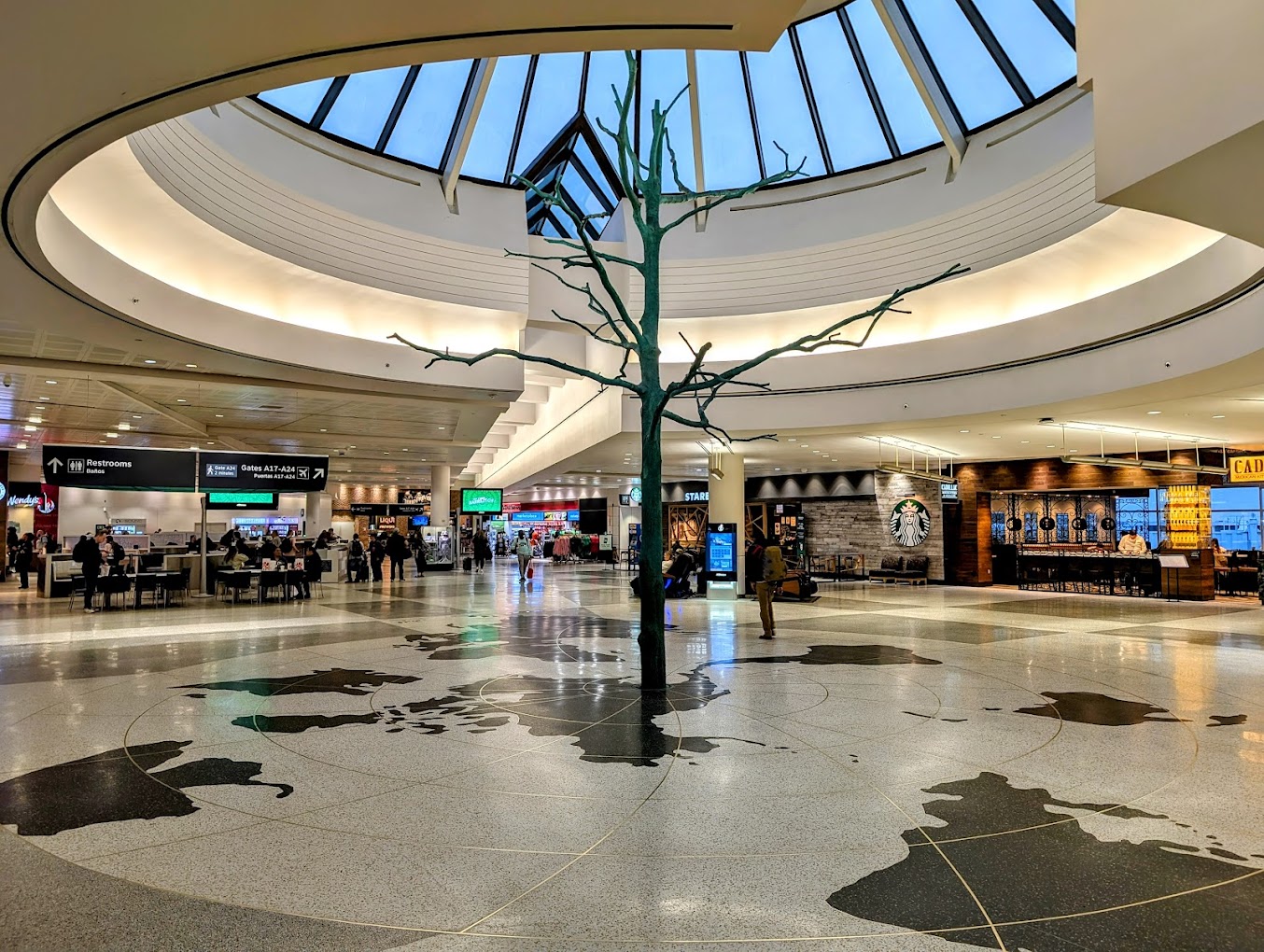
Every city has a front door. For Houston, that door swings open at 2800 North Terminal Road — the address of George Bush Intercontinental Airport (IAH), one of the busiest and most strategically important airports in the United States. Nearly 50 million passengers pass through here annually, making it not just a transit hub but a living, breathing reflection of what Houston has become: a global city with ambitions that stretch far beyond Texas.
But airports rarely get their due as cultural and economic artifacts. We sprint through them, complain about delays, and forget them the moment we reach our destinations. IAH deserves better than that. This is an airport that has quietly shaped Houston’s economy, its international identity, and the daily rhythms of millions of lives. And it’s time somebody told that story properly.
The Name on the Sign: A President’s Legacy
George Bush Intercontinental Airport wasn’t always called that. From its opening in 1969 until 1997, it was simply Houston Intercontinental Airport — a clean, functional name that told you exactly what it was and nothing more. Then the Texas legislature stepped in and renamed it in honor of the 41st President of the United States, George Herbert Walker Bush, who had long called Houston home and who represented, in many ways, the kind of dignified international statesman the city wanted to project to the world.
The renaming was not without controversy — it rarely is — but in hindsight it proved prescient. Bush’s legacy in foreign policy, his decades of service including stints as CIA Director and Ambassador to the United Nations, aligned well with an airport that had grown into a genuine hub of international connectivity. The name stuck, locals shortened it to “Bush Airport” or simply “IAH,” and today few people under the age of thirty even remember it was ever called anything else.
Finding Your Way There: Location and Access
IAH sits about 23 miles north of downtown Houston, nestled within a footprint that covers nearly 11,000 acres — making it one of the largest airports by land area in the United States. The official address for general airport inquiries and navigation is:
George Bush Intercontinental Airport 2800 North Terminal Road Houston, TX 77032
Getting there from Houston’s urban core takes roughly 30 to 45 minutes by car depending on traffic, a journey that takes travelers through the sweeping suburban sprawl of North Houston before the airport’s distinctive terminal complex comes into view. The main access roads are John F. Kennedy Boulevard (which connects to the terminals directly) and Will Clayton Parkway, both feeding off the Beltway 8 loop.
For travelers preferring public transit, the Metropolitan Transit Authority of Harris County (METRO) operates the 102 IAH Express bus route connecting downtown Houston to the airport, though Houston remains overwhelmingly a driving city. Rideshare services are plentiful and pickup zones are well-marked on the arrivals level of each terminal.
Five Terminals, One Massive Operation
One of IAH’s defining architectural facts is that it was built in phases rather than as a single unified structure. The result is a campus of five distinct terminals — A, B, C, D, and E — connected by an underground tunnel system with automated people movers that whisk passengers between concourses.
Terminal A — The original terminal when the airport first opened in 1969. Its architecture retains a distinct late-1960s quality, and it primarily serves domestic United Airlines flights. Address for Terminal A curbside: 18700 JFK Boulevard, Houston, TX 77032.
Terminal B — Adjacent to Terminal A and also serving United Airlines domestically, Terminal B is one of the more heavily trafficked concourses during peak morning hours.
Terminal C — Home to United’s international and domestic hub operations, Terminal C is the operational heart of IAH. This is where you’ll find the airport’s most sophisticated dining and retail offerings, and where the lines at passport control can stretch memorably long on busy international arrival days. Address: 18800 JFK Boulevard, Houston, TX 77032.
Terminal D — IAH’s dedicated international terminal, and arguably the most architecturally impressive of the five. Terminal D handles flights from carriers including British Airways, Lufthansa, KLM, Air France, LATAM, and dozens of other international operators. The soaring atrium ceiling and natural light make it feel less like an airport and more like a transit cathedral. Address: 18901 JFK Boulevard, Houston, TX 77032.
Terminal E — Primarily serving carriers other than United, Terminal E handles airlines including Spirit, Frontier, Southwest, and several others. It’s the airport’s most accessible terminal for budget travelers. Address: 18939 JFK Boulevard, Houston, TX 77032.
The people mover connecting these terminals runs 24 hours a day and is one of the airport’s genuinely underappreciated amenities — quiet, fast, and an efficient solution to what would otherwise be an impossibly long walk between the far ends of the complex.
United Airlines: The Airport’s Beating Heart
To understand IAH is to understand its relationship with United Airlines. The airport is one of United’s most important hub operations in the world — the carrier controls an enormous share of gates and operates more daily departures from IAH than any other carrier by a wide margin.
This arrangement has profound implications for Houston. It means direct routes to dozens of domestic cities and, critically, an extensive international network that connects Houston to cities in Europe, Latin America, Asia, and the Middle East without requiring a connecting stop. For business travelers, this is invaluable. For the Houston economy — which has significant interests in energy, petrochemicals, healthcare, and international trade — it’s close to indispensable.
The depth of United’s presence also means that when United faces operational turbulence (and what airline doesn’t), IAH feels it acutely. Weather delays at Chicago O’Hare or Newark can ripple through to Houston within hours, a consequence of operating within a hub-and-spoke network of this scale.
The International Dimension: Where Houston Meets the World
IAH consistently ranks among the top airports in the United States for international passenger traffic, and the scope of its international connections is genuinely impressive. Direct service operates to major cities in the United Kingdom, Germany, France, the Netherlands, Mexico (with an exceptionally broad network of Mexican city routes reflecting Houston’s deep cultural ties with its neighbor to the south), Colombia, Brazil, Peru, Panama, Japan, China, and beyond.
The Mexico connections deserve particular mention. IAH offers more direct flights to Mexican cities than almost any other U.S. airport. Destinations include Mexico City, Guadalajara, Monterrey, Cancún, Los Cabos, Puerto Vallarta, and several smaller cities that speak to the tight economic and familial bonds between Houston and Mexico. For Houston’s large Mexican-American community, IAH is not just an airport but a corridor connecting two homes.
The international arrivals experience at Terminal D has been substantially upgraded in recent years. New Customs and Border Protection processing lanes, automated passport kiosks, and improved wayfinding have reduced what was once a notoriously punishing experience. It still has its challenging moments — a wide-body aircraft discharging 400 passengers at the same time that three other international flights have landed creates lines that test any traveler’s composure — but the infrastructure is notably better than it was a decade ago.
Dining, Retail, and the Airport Economy
Airports have quietly become serious retail and culinary destinations, and IAH has leaned into this transformation with considerable energy. Across its five terminals, the airport hosts over 100 restaurants, bars, and retail shops — a number that has grown substantially as the airport’s management has sought to improve the traveler experience and capture more of the billions of dollars flowing through the campus.
Terminal C hosts some of the more upscale dining options. Local Houston brands have a strong presence throughout the airport, which reflects a broader industry trend toward celebrating regional food culture rather than defaulting entirely to national chains. You can find Tex-Mex, Gulf Coast seafood, and Houston barbecue alongside the standard international airport staples.
The retail mix includes bookstores, newsstands, electronics shops, and a range of branded stores. Duty-free shopping is concentrated in Terminal D, naturally, and the selection has improved as the terminal’s international passenger volumes have grown.
For travelers with long layovers, several of IAH’s terminals now offer charging stations, comfortable seating pods, and free Wi-Fi throughout, all significant quality-of-life improvements that the airport has invested in over the past several years.
The Economic Footprint: Numbers That Tell a Story
It’s easy to think of an airport as infrastructure — a cost center, a necessary piece of public plumbing. IAH is nothing of the sort. It is one of the most significant economic engines in the state of Texas.
According to Houston Airport System data, IAH and Houston’s other airports collectively support more than 300,000 jobs in the greater Houston region and contribute tens of billions of dollars annually to the regional economy. The Houston Airport System, which operates IAH along with William P. Hobby Airport and Ellington Airport, is a department of the City of Houston.
The cargo operations at IAH add another dimension to this economic picture. The airport handles substantial volumes of air freight — particularly valuable in industries like energy equipment, medical devices, and perishables — and has dedicated cargo facilities operated by major freight carriers. IAH’s cargo ramp address is located off Rankin Road, with major freight operations centered around the airport’s north cargo area.
For the oil and gas industry in particular, IAH’s international reach is a genuine competitive advantage for Houston. Energy executives, engineers, and specialists need to move quickly between Houston, London, Doha, Lagos, Singapore, and other energy capitals. Direct routing from IAH makes that possible in a way that no other Texas airport can match.
Getting Around the Airport: Practical Realities
IAH is large enough that it rewards preparation. A few practical notes that any traveler should have in hand before arriving:
The parking complex at IAH is substantial and well-organized. The main parking garage for Terminals A, B, and C is accessible from JFK Boulevard. Economy parking, which is considerably cheaper, is located further from the terminals with a dedicated shuttle service. Hourly parking is available in the terminal garages for those dropping off or picking up. Parking reservations can be made in advance online at the Houston Airport System’s website.
The Ground Transportation Center is located between Terminals B and C and serves as the staging area for taxis, rideshare pickups, hotel shuttles, and rental car shuttles. The rental car facilities themselves are located off-airport, reached by dedicated shuttle buses running continuously from the center.
For travelers with reduced mobility, IAH has dedicated accessibility services including wheelchair assistance, accessible restrooms throughout all terminals, and priority boarding coordination with all major airlines. The airport’s accessibility coordination line can be reached through the main airport number.
The Houston Airport System main information line is (281) 230-3000. For lost and found, the primary contact number is (281) 233-1969, and the lost and found office is located in Terminal C.
The Expansion Question: IAH’s Future
Houston is not a city that stands still, and neither is its airport. IAH has been the subject of ongoing capital improvement projects for years, reflecting both the demands of growing passenger volumes and the need to keep infrastructure competitive with peer airports in Dallas, Denver, and Atlanta.
The Houston Airport System has outlined ambitious long-term development plans for IAH, including potential new concourse development, improvements to Terminal B, continued technology upgrades to security screening and check-in processes, and sustainability initiatives aimed at reducing the airport’s environmental footprint. The airport has made commitments around solar energy adoption and electric ground support equipment, part of a broader aviation industry shift toward lower-emission operations.
The question of a potential consolidated rental car facility — a common infrastructure investment at airports of this scale — has been discussed for years. Currently the distributed shuttle model works but adds time to every traveler’s journey. A consolidated facility would streamline things considerably.
There is also ongoing conversation about improved public transit connectivity. Houston’s METRO system has expanded its rail and bus rapid transit network, and a direct transit link to IAH — something that exists at most comparable international airports worldwide — remains a long-discussed aspiration for the city. Whether the political and financial will exists to build it remains to be seen, but the conversation has grown more serious as Houston grapples with its transportation future.
The Human Geography of IAH
Any airport that processes tens of millions of passengers annually becomes, in a very real sense, a mirror of the society it serves. Walk through IAH on a busy afternoon and you encounter something genuinely remarkable: a cross-section of Houston’s extraordinary diversity.
Houston is one of the most ethnically diverse cities in the United States, a distinction it wears with considerable pride. That diversity shows up at IAH in vivid, human terms. You hear Spanish and Portuguese, Mandarin and Cantonese, Arabic and Hindi, Yoruba and Tagalog — sometimes within a single gate area. The airport’s customer service staff speak collectively dozens of languages, a practical necessity in an environment this international.
The airport also reflects Houston’s economic range. In the same terminal, you might see energy executives heading to London in business class, families traveling budget carriers to visit relatives in Central America, students heading home for university breaks, and oil field workers returning from months offshore. IAH serves them all, and the experience of moving through the airport — the shared rituals of security, the waiting, the boarding — creates an unlikely democratic commons.
A Final Word: The Airport as Institution
There is a reason that airports occupy such a particular place in the emotional geography of cities. They are places of departure and return, of anticipation and relief. They mark transitions — the beginning of an adventure, the end of an absence, the start of a business deal, the completion of a journey home.
George Bush Intercontinental Airport does all of this for Houston. It does it at scale, often under pressure, and with the particular character of a city that is big, confident, diverse, and deeply connected to the wider world.
The next time you pass through those terminals — rushing to make a connection, waiting out a delay, or simply standing at the gate watching the planes taxi — take a moment to appreciate what it actually represents. Twenty-three miles north of downtown, at 2800 North Terminal Road, Houston extends its hand to the world every single day.
That’s worth noticing.
George Bush Intercontinental Airport is operated by the Houston Airport System, a department of the City of Houston. General inquiries: (281) 230-3000. Airport address: 2800 North Terminal Road, Houston, TX 77032.