
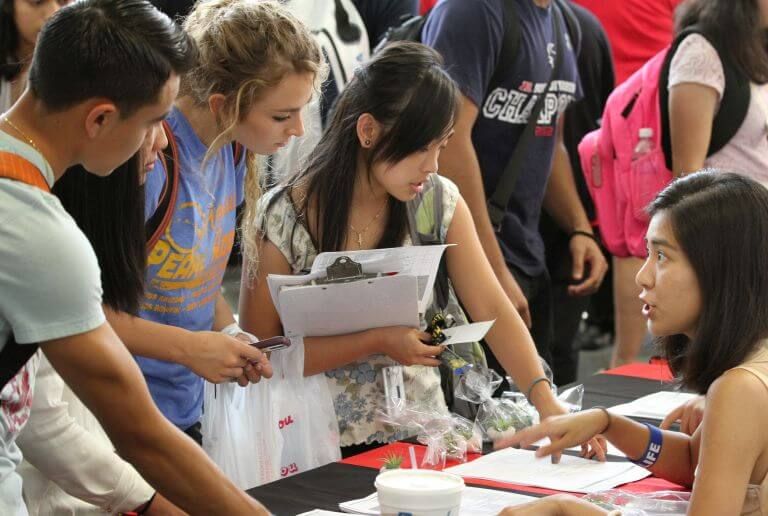
Houston has a reputation for being a lot of things — an energy capital, a space city, a food city with no zoning laws and consequently no shame about it. But there’s a quieter, more rewarding version of Houston that most residents drive past without stopping: the city’s sprawling network of universities and colleges, each running a near-constant stream of public events that most Houstonians don’t even know they’re allowed to attend.
They are. Almost always for free. Often world-class.
From Rice University’s music conservatory performances to the University of Houston’s flagship contemporary art museum, from public lectures by former mayors to ceramic artist workshops, Houston’s academic institutions collectively operate as a kind of shadow cultural infrastructure for the city — one that doesn’t require enrollment, alumni status, or a single dollar to access.
This is your guide to all of it.
Why Houston’s Campuses Are Worth Your Time
Before diving into specifics, it helps to understand just how much is happening on these campuses on any given week. Houston is home to the University of Houston system, Rice University, Texas Southern University, Houston Baptist University (now Houston Christian University), St. Thomas University, Lone Star College, Houston Community College across six campuses, and San Jacinto College, among others. Each institution maintains its own calendar of public programming — and because many of them compete for community goodwill as much as tuition dollars, they have strong incentives to keep those events accessible, affordable, and genuinely interesting.
The result is a city that, if you know where to look, offers something close to a perpetual intellectual and artistic festival running throughout the academic year.
University of Houston: The Most Underrated Cultural Institution in the City
The Blaffer Art Museum — Always Free, Always Provocative
If you’ve never visited the Blaffer Art Museum on the University of Houston’s main campus, that oversight is worth correcting this week. Founded in 1973, the Blaffer Art Museum endeavors to further the understanding of contemporary art through exhibitions, publications, and public programs, and positions itself as the gateway between the University of Houston’s central campus and the City of Houston — a catalyst for creative innovation, experimentation, and scholarship.
More importantly for the average Houstonian: its exhibitions and programs are free and open to the public, creating community through dialogue and participation, and inspiring an appreciation for the visual arts as a vital force in shaping contemporary culture.
The Blaffer isn’t the kind of museum that plays it safe. Since its inception 50 years ago, the museum has made it a focus to assist in the continued understanding of contemporary art through exhibitions, educational programming, and community outreach. The programming this year reflects that mission thoroughly. Kicking off 2026 with two new exhibits in January, The Uncanny In-Between ran through mid-March, featuring the work of several Korean ceramics artists, while Mud + Corn + Stone + Blue, a traveling exhibition, traces stories of major conflicts between the U.S. and indigenous communities.
The public programming surrounding these exhibitions is equally rich. Events include a public talk with Houston-based artist Tiffany Chung on her mid-career retrospective, a panel conversation and guided tour bringing together voices from the Great Plains and Central America to consider themes in the Mud + Corn + Stone + Blue exhibition, and a Ceramic Artist Demo Workshop with exhibiting artists Wansoo Kim and Hayun Surl.
The Blaffer also presents Mindful Museum — a series of intentional reflections and meditations inspired by the museum’s current exhibitions, led by invited wellness and meditation practitioners, where each session invites participants to slow down, center themselves, and experience art through a lens of mindfulness and presence. That’s a remarkable thing to find available for free on a Tuesday afternoon.
The Blaffer is open Tuesday through Friday from 10 a.m. to 5 p.m., and on weekends from noon to 5 p.m. Admission is always free. Getting there is easier than most people assume — it’s approximately a 12-minute walk from the METRO Elgin/Third Ward Purple Line station.
UH School of Theatre & Dance: Professional-Quality Productions at Accessible Prices
The School of Theatre & Dance at the University of Houston’s Kathrine G. McGovern College of the Arts has announced its 2025–26 season, featuring a vibrant mix of devised work, classical adaptations, contemporary plays, musical theater, student-written premieres, and innovative dance concerts.
The season’s offerings lean ambitious. The season opened with “The Circadian Project,” a devised physical theater piece created in collaboration with the genre-defying, award-winning PUSH Physical Theatre and UH students — an original work promising a boundary-pushing exploration of movement and storytelling. That was followed by Naomi Iizuka’s “Anon(ymous),” a poetic reimagining of Homer’s “Odyssey” that follows a young refugee on a journey to reunite with his mother after a perilous separation.
Spring offerings include the Tony Award-winning musical comedy “The 25th Annual Putnam County Spelling Bee,” which blends humor, heart, and improvisation as it follows an eclectic group of adolescents — played by adults — vying for spelling glory. Tickets are reasonably priced: general public tickets run $30, with discounts for staff, faculty, alumni, seniors, and students at $25. For a fully staged, professionally directed university production in an actual theater, that is not a bad deal.
As Sharon Ott, director of the School of Theatre & Dance, framed the season: “Our 2025–26 season celebrates the power of live performance across a wide spectrum. From the haunting beauty of ‘Frankenstein’ to the vibrant energy of student choreography and award-winning new plays, this season offers something for every audience.”
Convergence Research at the Blaffer: Art in Progress
One of the more unusual recurring events at UH is Convergence Research — a platform hosted jointly by the Blaffer and the Cynthia Woods Mitchell Center for the Arts. Students and faculty from across the disciplines — and beyond the arts — meet to discuss and present projects in a state of becoming, and all are welcome to attend, observe, and join the conversation. An edition in March 2026 took the event off campus entirely, hosting an immersive evening of performance and participatory exploration at ARTECHOUSE Houston, featuring works that trace the intersections of movement, mask, and identity.
Rice University: Where the Beautiful Campus Is Only Part of the Attraction
The Shepherd School of Music
Rice University’s Shepherd School of Music is one of the top conservatories in the country, and yet most Houstonians have never attended one of its performances. That’s a genuine loss. The Shepherd School has numerous performance spaces spread between two adjacent buildings — Alice Pratt Brown Hall and Brockman Hall for Opera — including Stude Concert Hall, Duncan Recital Hall, and the Wortham Theatre.
Throughout the academic year, the school stages a near-continuous series of recitals, chamber concerts, orchestral performances, and opera productions, most of them either free or very low cost. The caliber of musicianship at a school of this rank is genuinely remarkable — these are not hobbyist undergraduates playing in gymnasium acoustics. These are conservatory-trained students performing in purpose-built concert halls under faculty who have performed on the world’s major stages.
The Moody Center for the Arts: Rice’s Gift to the Public
Located on Rice University’s campus, the Moody Center for the Arts opened in 2017 with the goal of connecting the Rice community with the Houston public. The 50,000-square-foot building boasts an art gallery with three featured exhibits each year, a multimedia gallery for video installations, a maker space with wood, paint and metal shops, a 150-seat studio theater, office spaces for visiting artists, and a cafe. It offers free access Tuesday through Saturday, 10 a.m. to 5 p.m.
The Moody also has a robust event schedule and curates public art throughout Rice’s campus, including the Skyspace installation by James Turrell. The Turrell piece alone — a rooftop chamber designed to frame the sky and shift the viewer’s perception of light — is worth a separate trip. It has become one of the city’s most quietly extraordinary public experiences.
Public Lectures: Former Mayors, Wellness Researchers, and More
Rice’s continuing education arm — Rice Glasscock School of Continuing Studies — regularly presents free public lectures open to the entire community. Recent events included a talk by Annise Parker, former mayor of Houston and President of the Victory Institute, who shared insights on how Houston and other cities are shaping the world.
Other offerings included a session with Dr. Joseph Novak, director of Rice University’s Betty and Jacob Friedman Holistic Garden, exploring the many ways in which gardening and contact with nature can enhance wellness, well-being, community vitality, and personal creativity, followed by a hands-on workshop on potting, growing, and using fresh herbs.
Rice’s Department of Visual and Dramatic Arts also holds events like lectures and readings open to the public. These are not dusty academic affairs behind institutional walls — they are often intimate, engaging conversations with working artists and scholars.
University of Houston-Downtown: Community Engagement as Core Mission
UHD may be Houston’s least-discussed four-year university, but its Cultural Enrichment Center has spent years quietly building one of the city’s most genuinely community-oriented event calendars. The programming under the CEC’s umbrella tends to blur the boundaries between campus life and city life in productive ways.
UHD’s Annual Halloween Horror Film Screening transforms UHD’s North Deck into a lit-up site of artistic and cultural expression, community belonging, and public feelings — an evening of socialization, networking, and thinking through fear and disgust under the waning crescent moon. The language is intentionally academic, but the experience is simply a great outdoor film night.
The CEC also partners with institutions across the city. An event held at the Museum of Fine Arts, Houston in connection with the exhibition “From India to the World: Textiles from the Parpia Collection” brought renowned author and UH professor Dr. Chitra Banerjee Divakaruni — a best-selling author of 23 books and winner of the American Book Award — to lead a conversation on text and textile in Indian culture. The event was free; the speaker was world-class.
This is the CEC’s standard operating mode: take a campus program out into the city, partner with an established institution, and make it accessible to anyone willing to show up.
San Jacinto College: Dance, Performance, and the Arts for the Southeast Side
San Jacinto College often gets overlooked in conversations about Houston’s cultural offerings, despite running a meaningful performing arts calendar. San Jacinto College Dance presents the annual Artists for Hope charity concert, which includes free community master classes alongside performances by dance companies — held at the San Jacinto College South Campus. For dance lovers in the southeast Houston area, this event represents exactly the kind of neighborhood-level cultural programming that larger institutions don’t always reach.
Lone Star College: Visual Art on the Outskirts That Deserve Attention
Lone Star College — the massive community college system serving the suburbs and outer reaches of the metro — is quietly building a reputation for visual art programming. The Visual & Performing Arts Gallery at Lone Star College-University Park has recently showcased “Highways to Houston,” a solo exhibition of abstract paintings by Rebecca Pugh, with works inspired by the artist driving between Houston and College Station — abstracting cattle and horses as shapes of color and form.
This is the kind of contemporary regional work that rarely gets seen because it happens outside the Museum District’s gravitational pull. The gallery is open to the public, the admission is free, and the work is often more interesting than its low-profile venue suggests.
Houston Community College: Six Campuses, One City
Houston Community College spans six campuses across the city — Central, Northeast, Northwest, Southeast, Southwest, and Coleman — and operates a community calendar that attempts something genuinely ambitious: bringing programming to the neighborhoods that have historically been underserved by the arts institutions concentrated in Midtown and the Museum District.
The Coleman campus, located in the Texas Medical Center area, regularly hosts health-related public forums in partnership with neighboring institutions. The Northwest campus serves the Hwy 290 corridor and the area’s growing immigrant communities with programming that reflects the diversity of its student body. None of this is glamorous in the way that a Rice University lecture series might be, but it is accessible in a way that matters — geographically, linguistically, and economically.
How to Actually Find and Attend These Events
The barrier to attending most of these events is not financial or logistical — it is informational. These institutions all maintain event calendars, but they do not aggressively market to the general public. You have to go looking.
A few reliable starting points: The University of Houston’s main calendar at uh.edu/calendar covers the central campus and many affiliated units. The Blaffer Art Museum at blafferartmuseum.org publishes its programming in detail with dates, times, and registration links where applicable. Rice University’s events portal at events.rice.edu aggregates public events across departments. UHD’s Cultural Enrichment Center calendar is listed under the College of Humanities and Social Sciences on the UHD website. The Houston Cultural Events Calendar at houcalendar.com aggregates events across institutions, including campus-based programming.
For performing arts specifically, both the UH School of Theatre & Dance and the Shepherd School of Music maintain dedicated ticketing pages. Tickets for most UH Theatre productions can be purchased through the KGMCA Box Office. Shepherd School concerts are frequently free and listed individually on music.rice.edu/events.
One practical note: registration is sometimes required for free events, particularly lectures. Showing up without registering often still works, but it’s worth the two minutes to claim a spot.
The Case for Making Campuses Part of Your Cultural Rotation
There’s a particular pleasure in attending a university event as an outsider — as someone who didn’t enroll, has no grade riding on the outcome, and owes the institution nothing. The intellectual environment of a campus carries a kind of ambient energy that’s hard to replicate elsewhere: ideas being argued about seriously, work being made by people who are still figuring things out, faculty who have spent careers on questions that most of the world has never thought to ask.
Houston’s campuses offer that environment freely, repeatedly, and across virtually every discipline. A Thursday afternoon can take you from a Blaffer exhibition exploring indigenous land conflict through ceramics, to a Shepherd School string quartet rehearsal open to the public, to a Rice Continuing Education lecture on urban gardening and human wellbeing.
You could spend an entire academic year attending only campus public events in Houston and never lack for something worth showing up to. The city has built this cultural infrastructure, largely with public money and public goodwill. The only thing it requires in return is that you actually use it.
Show up. Bring someone. Most of the time, it won’t cost you anything except your afternoon — and it will be worth it.
For current listings, check each institution’s events calendar directly, as programming updates continuously throughout the semester. Most free events require no registration but benefit from an RSVP when one is offered.


