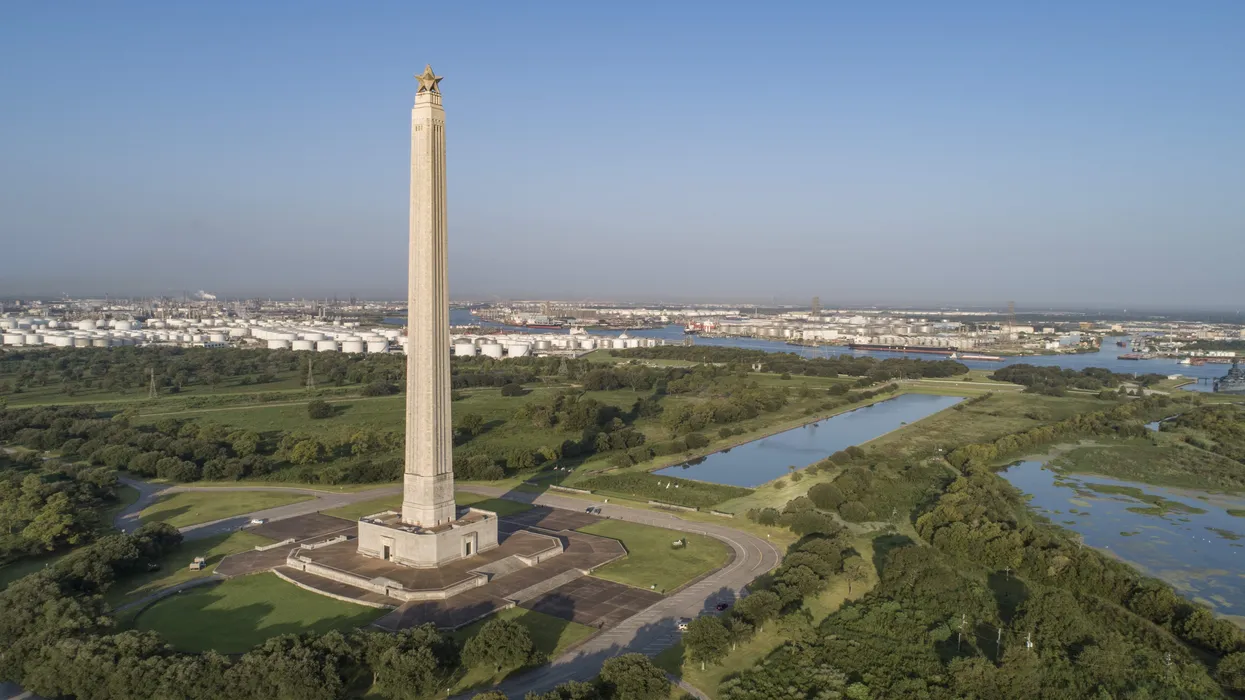
Imagine standing on the windswept plains of southeast Texas, where the humid air carries whispers of cannon fire and triumphant shouts from nearly two centuries ago. Rising like a sentinel from the marshy grounds, the San Jacinto Monument pierces the sky—a colossal shaft of stone that defies gravity and time itself. At 567 feet tall, it’s not just a structure; it’s a beacon of resilience, a testament to the audacious spirit that birthed the Lone Star State. This isn’t merely a historical site; it’s a living narrative etched in limestone and lore, where the echoes of an 18-minute battle still resonate through the halls of a museum nestled at its base. Welcome to the San Jacinto Museum and Monument, a place where history isn’t confined to dusty books but leaps out in vivid artifacts, panoramic views, and immersive stories. In this post, we’ll journey through the epic tale of the Battle of San Jacinto, the engineering feat of the monument, the treasures within the museum, and practical tips for your visit. Whether you’re a history buff, a curious traveler, or someone seeking inspiration from the past, this site promises to captivate your imagination.
The Battle That Shaped a Nation: From Defeat to Decisive Victory
To truly appreciate the San Jacinto Museum and Monument, we must first delve into the fiery crucible of the Texas Revolution. Picture this: It’s the spring of 1836, and Texas is a powder keg of rebellion against Mexican rule. General Antonio López de Santa Anna, the self-styled “Napoleon of the West,” marches into Texas with an army of over 6,000 men, determined to crush the upstart Texians who dare challenge his centralist regime. The conflict had been brewing since 1833, when Santa Anna dismantled the federalist constitution, sparking outrage among Tejanos and Anglo settlers alike.
The road to San Jacinto was paved with tragedy. Santa Anna’s forces laid siege to the Alamo in San Antonio, where defenders like Davy Crockett, Jim Bowie, and William B. Travis held out for 13 days before falling on March 6, 1836. All 189 Texian combatants were killed, their bodies burned in pyres—a grim spectacle meant to intimidate. Just weeks later, at Goliad, Colonel James Fannin and over 400 prisoners were executed on Santa Anna’s orders, an atrocity that fueled the Texians’ rage. These events weren’t just defeats; they were rallying cries: “Remember the Alamo! Remember Goliad!”
Enter General Sam Houston, a towering figure—literally and figuratively—in Texas lore. A former governor of Tennessee, Houston had thrown his lot in with the Texians, commanding a ragtag army of volunteers, settlers, and Tejanos. Outnumbered and outgunned, Houston played a masterful game of cat and mouse, retreating eastward in what became known as the “Runaway Scrape.” Civilians fled in panic, braving floods and mud, while Houston drilled his men and waited for the perfect moment. By mid-April, his force swelled to about 910 soldiers, including the famed “Twin Sisters” cannons donated from Cincinnati.
Santa Anna, overconfident after his victories, split his army to pursue the fleeing Texian government. On April 20, he camped his 700-man vanguard on a vulnerable plain near the San Jacinto River, with marshes at their back— a tactical blunder that Houston exploited. The next day, April 21, as Mexican troops rested after reinforcements arrived (bringing their total to around 1,360), Houston struck. At 4:30 p.m., under cover of artillery fire, Texian infantry charged across the open field, bayonets fixed and fury unleashed. The battle lasted a mere 18 minutes, but the slaughter continued for hours as panicked Mexicans fled into the swamps and Peggy Lake.
The outcome was staggering: Over 650 Mexicans killed, 208 wounded, and 300 captured, including Santa Anna himself, who was found hiding in the marshes disguised as a private. Texian losses? Just 11 dead and 30 wounded, including Houston, who took a bullet to the ankle. Captured the next day, Santa Anna negotiated the Treaties of Velasco, ordering his remaining forces to retreat south of the Rio Grande. This wasn’t just a win; it was the birth of the Republic of Texas, setting the stage for annexation to the United States and the Mexican-American War, which redrew North America’s map.
Creatively envisioning the scene: The sun dips low, casting long shadows over the prairie. Texian soldiers, a motley crew in buckskins and homespun, creep through the oaks. Suddenly, the air erupts with musket volleys and the thunder of cannons. Horses rear, men shout in Spanish and English, and in that chaotic ballet of smoke and steel, a nation’s destiny is forged. Today, standing on those same grounds, you can almost feel the ground tremble with the ghosts of that fateful afternoon.
The Monument: An Architectural Colossus Rising from the Plains
Fast-forward a century, and the battlefield’s significance demanded a fitting tribute. The San Jacinto Monument, completed in 1939, stands as the world’s tallest masonry column—a 567.31-foot Art Deco marvel that outstrips the Washington Monument by 12 feet. Conceived during Texas’s centennial celebrations, its construction was a symphony of ambition and engineering, costing $1.5 million funded by state and federal dollars.
Architect Alfred C. Finn and engineer Robert J. Cummins designed this octagonal shaft, clad in Cordova shell stone from a quarry near Austin. This limestone isn’t just beautiful; it’s a geological time capsule, embedded with fossils from 105 million years ago when Texas was an ancient sea. Touch the walls, and you’re connecting with prehistoric oysters and ammonites that once swam where buffalo now roam—or at least where they did before urbanization crept in.
Construction began on April 21, 1936—the battle’s centennial—and wrapped exactly three years later. Workers poured reinforced concrete, erected an octagonal base with friezes depicting key Revolution moments, and topped it with a 220-ton Lone Star. The base’s bronze doors showcase the six flags over Texas, while inscriptions inside narrate the Revolution in under 600 words. It’s not just tall; it’s symbolic, pointing heavenward like the “Ode to San Jacinto” poem that inspired it.
At the summit, an observation deck offers breathtaking views of the Houston Ship Channel, where massive tankers glide like modern-day galleons. On a clear day, you can see downtown Houston’s skyline, a reminder of how this rural battlefield birthed an urban powerhouse. The monument’s Art Moderne style—sleek lines, geometric motifs—evokes the optimism of the 1930s, a era when America built big to defy the Great Depression.
Creatively, think of the monument as a giant exclamation point punctuating Texas history. As you ascend the elevator (added post-war, thanks to philanthropist Jesse H. Jones), the hum of machinery mirrors the rising tension of the battle below. Emerging at the top, the wind whips your face, and suddenly, you’re not just viewing the landscape—you’re overseeing the domain that Houston’s victory claimed.
Inside the Museum: A Treasure Trove of Artifacts and Stories
Nestled within the monument’s base, the San Jacinto Museum is a 15,625-square-foot portal to over 500 years of regional history. Founded in 1938 as part of the centennial project, it was spearheaded by George A. Hill Jr., whose family ties to the battle ran deep—his grandfather fought there. Opening on April 20, 1939, the museum has weathered wars, hurricanes, and renovations, evolving into a dynamic repository of Texas heritage.
Step inside, and you’re greeted by immersive exhibits that span from pre-European indigenous cultures to the Republic era. Over 17,000 artifacts fill glass cases: Sam Houston’s gold “HONOR” ring, worn for 50 years; Colonel Juan Morales’ embroidered wool tailcoat from the Mexican army; swords, muskets, and uniforms that whisper tales of valor and defeat. The permanent collection includes armaments, paintings, and ephemera, while special exhibits rotate to keep things fresh.
Don’t miss the Albert and Ethel Herzstein Library, boasting 30,000 volumes and 400,000 manuscript pages— a scholar’s paradise for delving into primary sources. For a multimedia thrill, catch “Texas Forever!!” in the Jesse H. Jones Theatre, a 4D experience that recreates the battle’s chaos with rumbling seats and misty effects. It’s like stepping into a time machine, where the scents of gunpowder (simulated, of course) and the roars of charging soldiers envelop you.
The museum’s history is a story of perseverance. During World War II, staffing shortages plagued it, but directors like Dorothy Knepper steered it through, installing air conditioning in the 1960s and recovering from Hurricane Carla in 1961. In the 1980s, it celebrated Texas’s sesquicentennial with digital catalogs and its first website. Today, under the Texas Historical Commission since 2019, it partners with the battlefield association to expand programming.
Creatively, wandering the halls feels like eavesdropping on history. Imagine holding (virtually) Houston’s ring, feeling the weight of his decisions. Or gazing at a Mexican eagle emblem, pondering Santa Anna’s hubris. The museum doesn’t just preserve objects; it revives souls, making abstract events palpably human.
Visiting the Site: Practical Tips for an Unforgettable Experience
Planning a trip to this iconic landmark? The San Jacinto Museum and Monument is located at One Monument Circle, La Porte, Texas 77571-9585, about 20 miles east of downtown Houston. Nestled along the Houston Ship Channel, it’s easily accessible via I-10 or Highway 225—just follow the signs to the towering obelisk you can’t miss.
The grounds are open daily from 9 a.m. to 6 p.m., free to explore, offering self-guided driving tours, hiking trails through native prairie and tidal marshes, birdwatching (over 200 species!), and even fishing. The monument and museum operate Wednesday through Sunday, same hours. Admission: $14 for adults, $10 for seniors, veterans, and active military, $6 for children under 12. Combo tickets include the observation deck and theater show—worth every penny for the views and immersion.
Timing your visit? Spring brings wildflowers and the annual San Jacinto Day festival on April 21, with reenactments that transport you back to 1836. Costumed interpreters fire muskets, demonstrate camp life, and stage the battle—complete with smoke and drama. Fall events like the San Jacinto Fall Fandango (October 25, 2025) celebrate 1830s civilian culture with dances, games, and crafts. Family days offer hands-on activities, like making “shell stone” replicas from the monument’s fossil-laden limestone.
Pro tips: Wear comfortable shoes for exploring the 1,200-acre site; bring binoculars for birds and ships. Picnics are welcome, but no drones or pets in buildings. Accessibility: The site is wheelchair-friendly, with elevators to the deck. If you’re traveling with kids, book a school program—they’ll love the scout badges and interactive history lessons. And for a deeper dive, join volunteer opportunities: From prairie restoration to period acting, you can become part of the story.
Creatively, arriving at dawn, watch the sun gild the monument’s star, symbolizing Texas’s rise. Or visit at dusk, when the reflecting pool mirrors the tower like a watery dream, inviting reflection on freedom’s cost.
Events, Reenactments, and Living History
What sets San Jacinto apart is its commitment to living history. Reenactments aren’t stiff pageants; they’re visceral revivals. Picture hundreds of volunteers in period garb—Texians in fringed jackets, Mexicans in colorful uniforms—charging across the field. Cannon booms shake the ground, black powder smoke billows, and for a moment, you’re there in 1836.
The site hosts diverse events: Birdwatching tours every Saturday, revealing egrets and herons in the marshes; family workshops on fossils and Revolution flags. Special programs honor Tejanos like Juan Seguín, whose contributions are often overlooked. And for history nerds, the library’s manuscripts offer endless rabbit holes.
The Enduring Legacy: Why San Jacinto Matters Today
In a world of fleeting trends, the San Jacinto Museum and Monument stands eternal, reminding us of sacrifice’s fruits. This battle didn’t just win Texas independence; it catalyzed America’s westward expansion, influencing borders, cultures, and identities. Today, as debates rage over history’s interpretation, sites like this foster understanding—bridging divides between nations, as the museum’s charter promotes peace with Mexico and beyond.
Visiting isn’t passive; it’s participatory. Touch a fossil, climb the tower, watch a reenactment—and you’ll carry a piece of Texas spirit home. As the monument’s inscription declares, “Measured by its results, San Jacinto was one of the decisive battles of the world.” In our creative retelling, it’s more: A story of underdogs triumphing, of history alive and kicking.