
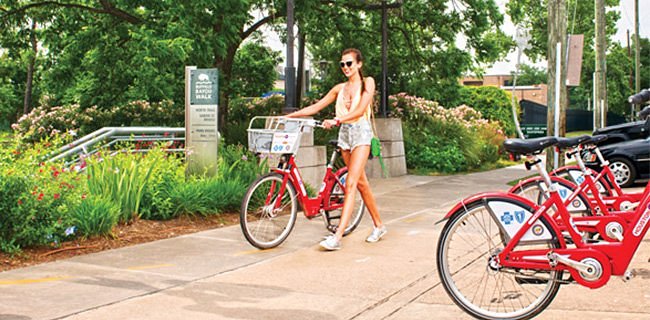
Houston, the city that invented the ten-lane freeway and the air-conditioned megamall, launched a bike-share system in 2012 with the quiet confidence of a man bringing a salad to a barbecue. Everyone predicted humiliation. The skeptics had receipts: 1,200 square miles of sprawl, 105-degree heat indexes, zero bike culture, and drivers who treat red lights as gentle suggestions. They gave the red bikes six months, maybe a year.
Thirteen years later, Houston BCycle is the largest bike-share system in Texas, the seventh-largest in the United States, and the only one in the South that has survived every attempt to murder it. Over 170 stations, 1,400 bikes (mostly electric now), 3.8 million rides, and a stubborn refusal to behave like a charity project. This is the story of the red bikes that Houston keeps underestimating.
Genesis: The Launch Nobody Asked For
May 2012. Three stations, twenty-one bikes, all parked in front of City Hall like a dare. Mayor Annise Parker cut the ribbon while reporters asked the only question anyone cared about: “Who is going to ride these in July?” The honest answer was almost nobody at first. The system limped along on $500,000 seed money from the city, Blue Cross Blue Shield sponsorship, and the blind optimism of a nonprofit board that believed Houstonians secretly wanted to sweat for transportation.
The first year produced 28,000 trips and endless mockery. The second year produced 110,000 trips and the first quiet realization that something was happening. By year five the system had 80 stations and was averaging 1,000 rides a day. The red bikes had discovered Houston’s dirty little secret: even in a car-worshipping city, thousands of people will choose two wheels if the alternative is paying $25 to park downtown.
The Near-Death Experiences (Plural)
Houston BCycle has died on paper at least four times.
- 2017: The original nonprofit ran out of money. The city threatened to yank the bikes off the streets.
- 2020: COVID emptied downtown offices. Ridership collapsed 68% overnight.
- 2022: Hurricane Ida’s Texas cousin flooded the warehouse and destroyed 400 bikes.
- 2024: The city council almost let the contract expire because “nobody uses them anymore.”
Every single time the system came back uglier, scrappier, and more popular than before.
The 2017 resurrection was pure Houston hustle. A last-minute coalition of the Greater Houston Partnership, downtown property owners, and the Astros (yes, the baseball team) wrote emergency checks. The 2020 rebound happened because hospitals and service workers suddenly needed cheap, no-contact transit when METRO buses felt like petri dishes. By 2023 the system had more rides than 2019, its previous peak year.
The Electric Revolution That Saved Everything
In 2021 BCycle made the single smartest bet in its history: it went electric.
The first 200 e-bikes arrived looking like regular red bikes wearing a backpack. They disappeared from stations so fast the staff thought they were being stolen. They weren’t. Riders were just refusing to return them. Within eighteen months the entire fleet flipped—80% electric, 20% classic. The average trip distance doubled from 1.8 miles to 3.6 miles. Suddenly the Medical Center to Midtown commute was twenty minutes instead of forty-five. Downtown to EaDo happy hour became a casual after-work glide instead of a sweat-soaked death march.
The e-bikes also rewrote the demographics. Women went from 28% of riders to 44% overnight. Age demographics tilted older—plenty of fifty-somethings now cruise past twenty-somethings too proud to admit they need the boost. The red bikes finally matched Houston’s actual population: practical, a little extra, and unapologetic about both.
The Geography of Red
As of December 2025 the stations form a lopsided heart across the city’s core.
- Inside the Loop: 120 stations so dense you’re never more than three blocks from a bike.
- Medical Center: 25 stations that move 8,000 rides a week, mostly nurses and med students who discovered that $5 beats $18 parking.
- Heights / Montrose / Midtown: the party triangle where Friday nights look like a red-bike invasion.
- East End: the newest frontier, with stations popping up along the new Green Line and the East River development.
- University Corridor: Rice, UH, TSU students treat BCycle like a free campus shuttle with better views.
The gaps are still glaring—third ward, fifth ward, and most suburbs remain red-bike deserts—but the expansion map for 2026 finally crosses I-45 east and west in multiple places. Progress tastes like 250-watt motors.
The People Who Ride (and the People Who Love Them)
The average BCycle rider in 2025 is 34 years old, makes $75,000 a year, and owns at least one car they happily leave in the garage three days a week. They are baristas getting to their 5 a.m. shift, lawyers dodging I-45 traffic, and night-shift janitors who discovered that the $11 monthly pass is cheaper than one tank of gas.
Annual members (35,000 strong) treat the system like a cult. Day-pass tourists treat it like a scavenger hunt. Drunk people at 1:30 a.m. treat it like Uber with training wheels. All of them are right.
The Numbers That Refuse to Be Ignored
- 3.8 million total rides (2012–2025)
- 1.1 million rides in 2024 alone (new record)
- 11.2 million miles pedaled/assisted
- 4.8 million pounds of CO₂ kept out of Houston’s already angry air
- 1,400 bikes, 1,200 of them electric
- 99.97% uptime on the app (better than half the parking garages downtown)
- Zero fatalities, ever (a statistic Houston drivers find personally offensive)
The Haters (and Why They’re Losing)
Every city has its bike-share haters. Houston’s are louder because everything here is louder.
“The bikes are always broken.” (They’re not. The repair team turns 98% of reported issues in under 24 hours.) “Nobody uses them.” (Tell that to the 4,200 daily rides in October 2025.) “They block the sidewalk.” (Stations are designed to fit in parking lanes; the ones on sidewalks replaced car spaces, not pedestrian space.) “It’s just for white people in spandex.” (Forty-six percent of 2024 riders were people of color; the e-bikes killed the spandex requirement.)
The loudest critic remains the Houston driver who has never once been delayed by a red bike but feels morally certain that one day it will happen.
The Secret Sauce: Corporate Houston Finally Grew a Conscience
Downtown property owners realized that every BCycle ride is one less car circling their garages. The Medical Center hospitals realized that nurses who bike to work call in sick less often. Energy Corridor companies realized that e-bikes are the only way their employees will ever see daylight during winter 5 p.m. traffic.
The result is the most corporate-funded bike-share in America. CenterPoint Energy, H-E-B, Memorial Hermann, and a dozen others pay six-figure sponsorships not because they love cycling but because they love cheaper parking and healthier employees. It is the most Houston solution possible: altruism disguised as capitalism.
The Future That Is Already Here
By 2026 the system will hit 200 stations and 2,000 bikes. The new “BCycle Boost” e-bikes coming in spring have 500-watt motors and 100-mile range—enough to ride from Katy to Galveston if you hate yourself enough. The long-promised integration with METRO’s Q-card is finally real: one tap, one fare, one less excuse.
The holy grail—continuous expansion beyond the Loop—depends on a 2026 bond vote that would fund protected lanes and 300 more stations over ten years. Early polls show 68% support. Even Houston’s suburbs are starting to whisper that maybe, just maybe, red bikes aren’t the apocalypse.
The Final Verdict
Houston BCycle is the civic equivalent of the cockroach in the best possible way: ugly to some, impossible to kill, and perfectly adapted to its environment. It has survived bankruptcy scares, hurricanes, pandemics, and the unique hostility of a city that measures success in lane miles. It has turned a metropolitan area famous for hostility to anything that isn’t air-conditioned and gasoline-powered into a place where 4,000 people a day choose a red bicycle over a pickup truck.
The bikes themselves are nothing special—solid aluminum frames, Nexus hubs, batteries made in some factory in Guangdong. The magic is that they exist at all in a city that once believed human-powered transportation was a personality flaw.
Every time a nurse coasts down the Columbia Tap trail at sunset, every time a Rice student locks a bike outside a Midtown bar at 1 a.m., every time an Astros fan pedals to a playoff game instead of paying $50 to park, the red bikes win another small, quiet victory against the idea that Houston can only be experienced from behind tinted glass.
The system’s unofficial slogan should be printed on every basket: “We’re not for everyone. We’re just for more people than you thought.”
In a city that still worships the horsepower and the HOV lane, that is revolution enough.


