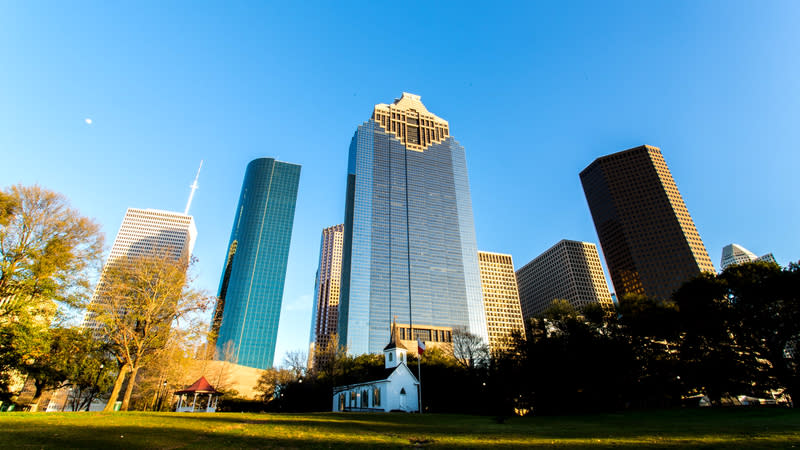
Tucked into the exact spot where Buffalo Bayou makes its lazy S-turn beneath the Bagby Street ridge, the park holds eight historic buildings that once stood somewhere else in the city, picked up and carried here like children rescued from a fire. Around them spreads a live-oak cathedral older than Texas itself. On a December morning in 2025 the air smells of woodsmoke from the 1823 log cabin, coffee from the Heritage Society tearoom, and the faint metallic tang of the bayou after rain. A rooster from the 1847 Kellum-Noble barnyard crows at a drone delivering someone’s lunch to the Exxon building across the freeway. The collision is perfect. This is Houston refusing to forget itself while simultaneously refusing to slow down.
Most cities exile their past to the suburbs. Houston keeps its past on life support in the geographic dead center of everything, surrounded by glass, traffic, and ambition. Sam Houston Park is the city’s conscience wearing overalls.
The Accidental Museum
The park began as an act of desperation. In 1899 the magnificent 1838 Pillot house at San Jacinto and Dallas was about to be demolished for a parking lot. A handful of women (daughters and granddaughters of the Republic) formed the Daughters of the Republic of Texas and begged the city for one acre “in perpetuity” to save it. The city fathers, amused, said yes. They assumed the ladies would run out of money or enthusiasm within a decade. Instead, the women bought the house, jacked it up, rolled it on logs pulled by mules across half of downtown, and plunked it down on the chosen acre like a hen settling on an egg.
That first act of architectural kidnapping set the pattern. Every time a developer’s wrecking ball swung toward something irreplaceable, someone called The Heritage Society (founded 1954) and the building was bargained for, bought, or quietly stolen in the night. By 2025 the park holds:
- The 1823 Old Place – the oldest standing structure in Harris County
- The 1847 Kellum-Noble House – Houston’s first brick dwelling
- The 1868 St. John Church – German Gothic built by freedmen
- The 1870 San Felipe Cottage – a dogtrot that once housed Sam Houston Jr.
- The 1891 Nichols-Rice-Cherry House – Victorian wedding cake rescued from Main Street
- The 1905 Pillot House – Second Empire with dog-head newel posts
- The 1915 Yates House – Craftsman bungalow of an African-American pharmacist
- The 1924 Staiti House – oil-boom Mediterranean fantasy
Each building arrived with its own saga of midnight negotiations, last-minute donations, and volunteers who chained themselves to porches. The park is less a planned museum than a refuge for buildings that refused to die.
The Nineteen Acres That Time Forgot (Mostly)
Walk through the Allen Parkway gate and the noise of the city drops thirty decibels. The live oaks (some 200 years old) form a green tunnel that blocks sightlines to the skyscrapers until you choose to look up. Spanish moss drips from branches like lace curtains. The ground is carpeted in fallen acorns and the occasional empty Lone Star can tossed over the fence by someone who doesn’t understand the assignment.
Paths are crushed granite thatch and oyster shell, deliberately uneven so visitors slow down. Every building is painted its documented historic color (mustard yellow, oxblood red, arsenic green), colors so loud they feel subversive against the beige skyline. The rooster crows again. A peacock named General Sam (descendant of the original 1960s escapee from the zoo) struts across the lawn like he owns the mineral rights. Children on field trips chase him while docents pretend to scold.
The park smells different in every season. Spring brings Confederate jasmine so thick it makes strangers sneeze in unison. Summer smells of creosote from the railroad ties along the bayou and the faint sweetness of figs dropping from the 1890s tree beside the Pillot dogtrot. Fall is woodsmoke and burning leaves. Winter is the sharp green bite of the cedar the staff cuts for Christmas wreaths.
The Buildings Talk If You Listen
The Old Place, 1823
A single-pen log cabin with a sleeping loft and a chimney made of bayou mud and oyster shells. Inside, the air is twenty degrees cooler and smells of cedar smoke and lye soap. A reenactor in homespun linen fries cornbread on a hearth that has never been modernized. When the wind is right you can hear the freeway and the crackle of the fire at the same time, and the cognitive dissonance is delicious.
Kellum-Noble House, 1847
The brick was made on-site by enslaved labor. The walls are eighteen inches thick and still cool to the touch in August. The parlor piano once belonged to Varilla Royston, who played “The Yellow Rose of Texas” for Sam Houston the night before San Jacinto. On quiet afternoons the current curator swears the keys depress themselves when no one is looking.
St. John Church, 1868
Built by formerly enslaved Germans who refused to worship in the white churches downtown. The pews are scarred by generations of pocket knives. Sunlight through the ruby glass turns the floor blood-red at 4 p.m. every solstice. The bell in the tower still rings for weddings and funerals, and the sound carries all the way to the Fourth Ward.
Yates House, 1915
Dr. Rupert Yates was one of Houston’s first Black pharmacists. His house arrived in 1998 after a decade-long court battle with a developer who wanted the lot for condos. The Heritage Society won by proving the house was a rare intact example of middle-class African-American life during segregation. Inside, the original 1920s pharmacy counter displays cough syrups laced with cocaine and heroin (perfectly legal at the time). Children stare wide-eyed while parents shift uncomfortably.
Every building is furnished to a specific year. Nothing is behind glass. You can sit in the rocking chair on the San Felipe Cottage porch and feel the same breeze that cooled Sam Houston’s grandchildren. You can lie on the rope bed in the Old Place loft and stare at the same hand-hewn beams that sheltered the town’s first smallpox outbreak. The past is not recreated here; it is simply paused.
The Tearoom at Noon, Candlelight at Dusk
The Heritage Society Tea Room operates out of the 1905 Pillot carriage house Wednesday through Saturday. The chicken salad is legendary, the pecan pie illegal in three states, and the sweet tea strong enough to wake the dead. Downtown lawyers in $3,000 suits sit elbow-to-elbow with great-grandmothers in Easter hats. The waitstaff are volunteers who know every ghost story and will tell you which chair Sam Houston actually sat in (it’s the one with the burn mark from his cigar).
After 4 p.m. the park flips. The school groups leave. The gates stay open until 10 p.m. for the candlelight tours that run October through March. Docents in period dress lead small groups by lantern light. The temperature drops. The buildings creak. Somewhere in the dark General Sam the peacock screams like a dying woman. More than one visitor has sworn they saw a woman in a gray hoop skirt glide across the Pillot porch and vanish into the azaleas.
The Animals That Run the Place
The park’s livestock program is equal parts education and chaos. Two longhorn cows, three goats, a dozen chickens, and the aforementioned peacock roam fenced pastures that look lifted from a 19th-century farm. The goats (named Bonnie and Clyde) have escaped 47 times since 2019, usually to graze the median on Allen Parkway during rush hour. The longhorns once wandered into the Exxon lobby during a shareholder meeting. Security called animal control; animal control called the Heritage Society; the cows knew the way home).
The star is Mirabeau, a 1,600-pound longhorn steer who lets toddlers sit on his back for photos and then gently deposits them in the dirt when he’s bored. He has his own Instagram account with 87,000 followers and a sponsorship deal with a local distillery that makes “Mirabeau’s Bourbon Barrel-Aged Stout.”
The Wedding Factory
Sam Houston Park is the most-booked wedding venue most Houstonians don’t know exists. The 1868 St. John Church seats exactly 80 people and books two years in advance. Brides love the ruby light through the windows. Grooms love that the bar can be set up in the adjacent 1847 brick kitchen without violating any open-container laws. The Heritage Society has a running joke that half the city’s Gen-Z population was conceived in the azalea bushes after a reception.
The most famous wedding was in 2023 when Beyoncé’s cousin rented the entire park for a private ceremony. Security was tighter than a Astros playoff game, but Mirabeau still photobombed the couple’s first kiss.
The Christmas That Almost Wasn’t
Every December the park hosts “Candlelight Tour and Christmas in the Quarters,” a sold-out recreation of Christmas 1863 in Confederate Houston. The buildings are lit only by candles and oil lamps. Enslaved reenactors in the Kellum-Noble kitchen cook hog jowl and black-eyed peas over an open hearth while Confederate soldiers in the parlor argue about Vicksburg. The dissonance is deliberate. Visitors leave quieter than they arrived.
In 2020 the event was canceled for COVID. The staff decorated anyway, for the buildings, they said. On Christmas Eve a lone trumpeter stood on the St. John porch and played “O Holy Night.” Someone started livestreaming. By the second verse half of downtown was watching on the sidewalks outside the fence, masked and six feet apart, singing softly. The video went viral. The park raised $180,000 in donations that night from people who had never set foot inside.
The Bayou That Keeps Trying to Reclaim Everything
Buffalo Bayou runs along the park’s southern boundary like a restless neighbor. During Hurricane Harvey the water rose twenty-eight feet and turned the entire park into a lake. The Old Place floated off its piers and had to be winched back like a wayward barge. The goats rode out the storm on the second floor of the carriage house. When the flood receded, the only thing seriously damaged was the gift shop’s inventory of snow globes.
The park staff now jokes that the bayou is the ninth historic structure (it just refuses to stay in one place).
The Future That Knocks Politely
By late 2025 the park faces the same pressure that created it: downtown land is worth more as condos than history. A developer has offered $120 million for the air rights above the park to build a 45-story tower whose shadow would fall across the Old Place every afternoon. The Heritage Society’s response was to buy the adjacent surface parking lot and turn it into a native-plant meadow with a sign that reads “Future Home of Nothing.”
The city blinked first.
The park’s master plan for 2030 calls for a new visitor center disguised as an 1890s train depot, a children’s history playground built from decommissioned oil pipe, and (most controversially) moving the 1924 Staiti House thirty feet north to make room for a bayou overlook. Old-timers are already chaining themselves to the columns in protest.
One Quiet Tuesday in Autumn
I was there last month on a weekday when the park was almost empty. A groundskeeper raked leaves beneath the 200-year-old oaks. A bride in cowboy boots posed for photos on the church steps while her fiancé practiced his vows aloud to Mirabeau, who listened with the patience of a therapist. Inside the Pillot House a volunteer was polishing the dog-head newel post with lemon oil. The smell drifted across the porch and mixed with the woodsmoke from the Old Place chimney.
At noon the St. John bell rang twelve times. For a moment the only other sound was the breeze moving through the moss. Then a Metro bus hissed past on Allen Parkway and the spell broke. A child laughed. The rooster crowed. General Sam screamed. The city rushed back in.
Sam Houston Park had done its job again. In nineteen acres it held everything Houston was, everything it fears becoming, and everything it still secretly wants to be (all at once, without apology, in the exact center of the storm).
That is the only trick it knows, and it never gets old.