There are art installations, and then there are experiences that quietly rearrange something inside you. Undercurrents, the new commission by Mexican-Canadian artist Rafael Lozano-Hemmer at Houston’s Buffalo Bayou Park Cistern, belongs firmly in the second category. Opening April 24, 2026, and running through January 24, 2027, it is the most ambitious, most participatory, and arguably the most emotionally resonant work ever staged in one of America’s most unusual art spaces. It is also arriving at a meaningful moment: the Cistern’s centennial year.
To understand why Undercurrents matters, you first have to understand the room it lives in.
A City’s Hidden Secret: The Buffalo Bayou Park Cistern
The Buffalo Bayou Park Cistern is a former drinking water reservoir built in 1926 for the City of Houston. For most of its existence, it was invisible — a subterranean utility, quietly doing the unglamorous work of supplying water to a growing city. Then, after decades of service, an irreparable leak was found and the reservoir was decommissioned in 2007. It sat largely forgotten until, in 2010, Buffalo Bayou Partnership rediscovered the largely forgotten site while developing Buffalo Bayou Park. Recognizing its historical and architectural significance, BBP retained the Houston-based architecture and engineering firm Page to restore and repurpose the Cistern into the magnificent public space it is today.
What they uncovered was extraordinary. An underground chamber the size of 1.5 football fields, it was built in 1926 to store up to 15 million gallons of drinking water for the growing city. The site provides a number of interesting limitations and opportunities for a site-specific artist, including a vast pool of reflecting water, a seventeen-second echo, and an array of 221 concrete columns that hold up the ceiling and divide the space visually into an uneven grid that changes based on the viewer’s location around the perimeter walkway.
That seventeen-second echo is not a footnote. It is essentially a co-author of every single artwork that has ever been shown inside these walls. Sound doesn’t just travel in the Cistern — it lingers, layers, and returns to you transformed. The still black water underfoot mirrors everything above it, so the columns seem to multiply downward into a second underground forest. The effect, even on a simple guided tour, is of stepping out of time.
Ahead of this year’s anniversary, the organization undertook a $200,000 reinforcement project aimed at preserving the cistern — what leaders called the first significant structural investment since it opened to the public ten years ago. The Cistern’s centennial is not being treated as a birthday party. It’s being treated as the beginning of another hundred years.
A Decade of Bold Artistic Visions
Since Buffalo Bayou Partnership began programming art in the space in 2016, past installations include Magdalena Fernández’s Rain (2016–2017), Carlos Cruz-Diez’s Spatial Chromointerference (2018–2019), Anri Sala’s Time No Longer (2021–2022), Rachel Rossin’s Haha Real (2024), and Kelly O’Brien’s popular Cistern Illuminated, which ran in 2022, 2023, and again in 2025–2026.
Each artist has had to reckon honestly with the Cistern’s overwhelming physical character. The columns demand attention. The water demands respect. The echo demands humility. Cruz-Diez, born the same year the Cistern was built, bathed every single column in shifting chromatic light, turning the space into a living color field. Anri Sala used a semi-transparent screen bisecting the space and a floating record player orbiting in a fictional space station to conjure a meditation on time, loops, and what gets left behind. Kelly O’Brien’s annual Cistern Illuminated became a beloved Houston tradition — proof that people were hungry to return again and again.
But all of those works, as spectacular as they were, shared one quality: they were largely things to witness. Undercurrents is the first commission that truly asks you to participate in the making.
Enter Rafael Lozano-Hemmer: The Artist Who Believes Art Is Incomplete Without You
Rafael Lozano-Hemmer was born in 1967 in Mexico City. He creates interactive works and emphasizes that his installations are incomplete without public participation, treating audience participation as an essential material in his creative process. That sentence — installations are incomplete without the public — is worth sitting with. In an era of passive consumption, of art that asks only for your gaze, Lozano-Hemmer insists on your presence as a literal ingredient.
An artist working at the intersection of architecture and performance art, Lozano-Hemmer creates participatory artworks that utilize technology like robotics, heart-rate sensors, and computerized surveillance tools in order to facilitate human connection. Technologically sophisticated yet deceptively simple in their execution, his spectacular, immersive works are often installed in public places as a means of transforming these sites into forums for civic engagement.
His scientific background is not incidental. He received his Bachelor of Science in Physical Chemistry from Concordia University in Montreal and initially worked in a molecular recognition lab in Montreal, publishing research in Chemistry journals. The son of Mexico City nightclub owners, he was caught between the empirical and the ecstatic from the very beginning, and his art has spent thirty years trying to resolve that tension — usually by inviting strangers into the middle of it.
His track record speaks for itself. He has had major solo exhibitions at the Hirshhorn Museum, Smithsonian Institution; the Guggenheim Museum, New York; the Barbican Centre, London; the San Francisco Museum of Modern Art; and many others. He was the first artist to represent Mexico at the Venice Biennale in 2007. Works like Pulse Room — in which a heart-rate sensor records participants’ pulses and prompts hundreds of installed lightbulbs to flash in their rhythm — made his reputation as an artist who turns the human body into a kind of instrument. His 2019 Border Tuner connected people across the US-Mexico border using bridges of light controlled by the voices of participants in Ciudad Juárez, Chihuahua and El Paso, Texas. The emotional stakes of that piece were immense, and it worked — because Lozano-Hemmer understands that the most powerful technology in the world is still a human voice.
Which brings us, perfectly, to Undercurrents.
What Undercurrents Actually Is
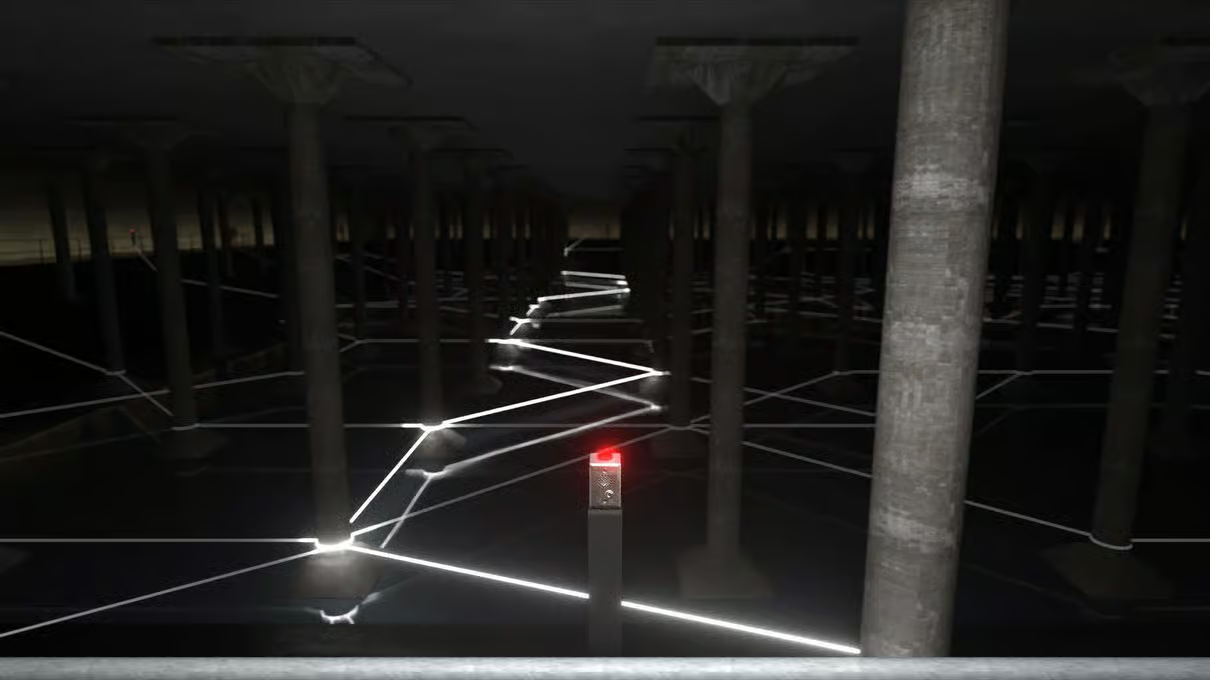
Undercurrents is a site-specific immersive piece employing sound, light, and interactive technology to visualize systems of communication. The visual component of the installation is described as “a mile-long, nerve-like labyrinth of white LED linear lights” suspended between the 25-foot-tall pillars in the 87,500-square-foot cistern. Water covering the floor will act as a mirrored surface doubling the spectacle.
Read that again. A mile of LED wire, suspended in a web between 221 concrete columns, reflected in still water below. The geometry alone is staggering. Every angle offers a different configuration of light and shadow, of wire and column and reflection. The space, already disorienting in the best possible way, becomes something that resists easy description.
But the light is only half the story. Intercoms will be installed around the cistern walkway so that visitors can speak into the system and watch their words flow through Lozano-Hemmer’s piece. Visitors are encouraged to use the intercoms to record brief messages, which are then encoded and displayed as light pulses in an array of patterns communicated at the water’s surface. These ever-changing light currents are the visual “voice” supplied by visitors’ recorded messages mixed with the recorded spoken works by five Houston writers.
This is where the piece becomes genuinely moving. Your voice — your actual words, spoken into an intercom in a 100-year-old underground cistern — becomes light. It travels along a mile of wire, bouncing between columns, doubling in the water’s reflection, mingling with the voices of Houston poets and strangers who were here before you. You are not watching communication happen. You are the communication.
The still reflective surface of the cistern water doubles the effect, creating a mirrored set of racing pulses that fly through the gloom like thoughts along neural pathways. That image — thoughts along neural pathways — captures something essential about what this installation is trying to do. It makes the interior life visible. It externalizes the invisible signals we send each other constantly, and shows them as what they actually are: beautiful, erratic, brief, and deeply human.
Why the Cistern Is the Perfect Host for This Piece
There are works of art that can be installed anywhere and remain themselves. Undercurrents is not one of those works. It exists in specific, necessary conversation with this building, this history, this city.
Consider the resonances. The Cistern was built to hold and distribute water — to be the hidden infrastructure that kept a city alive. It moved something essential, invisibly, through a network of pipes and channels and pressure systems. Undercurrents now moves something equally essential — human voices, words, connection — through a network of wires and light pulses and coded signals. The metaphor is not imposed from outside. It is built into the very walls.
After operating for decades, an irreparable leak was found and the reservoir was decommissioned in 2007. The Cistern failed at its original task. It could no longer hold water. What it can hold, it turns out, is memory — acoustic memory, artistic memory, and now, with Undercurrents, the literal recorded voices of the people who pass through it. That is a remarkable second life for a utilitarian structure.
The seventeen-second echo matters here in a way it has never mattered before. In previous installations, the echo was a feature, something artists worked with or around. In Undercurrents, the echo is part of the medium. When you speak into one of the intercoms and your voice is encoded as light, the physical sound of your voice also travels the space, bouncing off columns, hanging in the air far longer than it would anywhere else. You speak, and the room keeps speaking. The light pulses fade, but the echo doesn’t leave immediately. There is a doubling of duration built into the experience.
Voices, Poetry, and the People of Houston
Recordings of poetry by Houston writers will be mixed in with visitors’ voice messages. This detail is quietly significant. Undercurrents is not a tourist attraction that happens to be in Houston. It is anchored in this specific city, woven through with the written and spoken voices of local poets whose words will pulse through the LED grid alongside the improvised messages of people who drove in from Katy or Montrose or the Heights.
There is a democratic generosity to this. The work does not privilege the prepared voice over the spontaneous one. A poet’s crafted stanza and a child’s whispered hello both become the same medium — light — and travel the same network. In Undercurrents, the Cistern becomes a kind of archive that keeps no permanent record but keeps everything for just long enough to make it beautiful.
Karen Farber, BBP Vice President of External Affairs, called Undercurrents the organization’s “first truly interactive installation in the Cistern” and said it offers visitors “not only something to behold, but something to become a part of.” That framing is exactly right, and it represents a meaningful evolution in the Cistern’s artistic programming. For ten years, the space has been a place to witness. Now it is a place to participate. That is not a small shift.
The Experience Itself: What to Expect When You Visit
Reserved tickets are available for 30-minute timed visits on Wednesdays through Sundays, priced at $15 or $12 for seniors, students, and members of the military. Due to the special nature of the work, Undercurrents will only be able to be viewed by 45 visitors at a time, in groups admitted every 15 minutes.
That limit — 45 people — is worth appreciating rather than lamenting. It means you will never experience Undercurrents in a crowd. The space will feel intimate. The voices around you, including the ones pulsing through the wire grid, will be audible and human-scaled. This is not the overwhelm of a stadium concert. It is closer to a ritual.
The cistern is open 10am–5pm Wednesday through Sunday. It was closed from March 30 through April 23 to install the work — a timeline that suggests the technical complexity of suspending a mile of LED wire between 221 columns while maintaining the reflective water surface below. The logistics alone are an act of devotion.
Free admission remains available on the first Thursday of each month, a long-standing Cistern tradition that ensures this experience is not locked behind a paywall for those who can’t readily spend $15.
Undercurrents and the Larger Question of What Public Art Can Do
There is a version of this story that is simply a review of a cool light show. That version is true, but it misses something important.
Lozano-Hemmer’s interactive works are described as “anti-monuments for people to self-represent.” In an era when most monuments are fixed — bronze generals on horses, plaques commemorating the powerful — the anti-monument is something that changes with every person who encounters it. It doesn’t tell you what to think about history. It asks you to add yourself to it. Your voice joins the archive. Your pulse, elsewhere in his work, sets light to flickering. You are the content.
Undercurrents arrives in a city that has been thinking hard about its own identity, its infrastructure, its relationship to water after years of flooding, hurricanes, and the long reckoning of a changing climate. Houston is a city built around and against water — bayous running through neighborhoods, reservoirs underground, the Gulf looming at the horizon of the collective imagination. An art installation in a former water reservoir that turns human voices into flowing currents of light is not an accidental metaphor for this city. It is almost too precisely tuned.
Lozano-Hemmer’s work is conceived as “public and interactive art: intimate game, accomplice, but also evocative.” The artwork dies when the body no longer has contact with the device and reappears in space when a new body comes in and activates it. What this means in the Cistern is that Undercurrents will never be the same experience twice. The group that enters at 10am will create a different network of light than the group that enters at 3pm. The poets’ voices will recur, but the spontaneous additions will not. Every half-hour is a different piece, made by different people, sent along the same wire.
The Centennial and What Comes Next
Undercurrents opens as part of a broader centennial celebration of the Cistern’s 100th year. The new art installation will kickstart a month-long calendar of special events and activations, such as public performances and readings, to celebrate the Buffalo Bayou Park Cistern’s centennial year. For a space that spent most of its existence underground and forgotten, this feels like an overdue reckoning with its own significance.
The Cistern has, in ten years of programming, quietly become one of the most distinctive art venues in the United States. Not because of its budget, but because of its irreplicability. No other space in the country sounds like this, looks like this, or carries this specific combination of industrial history and acoustic strangeness. Artists who work site-specifically — who make work for a place rather than in it — find the Cistern irresistible because the space is already doing so much of the work. The challenge is to meet it at its own level.
Lozano-Hemmer has done that, and perhaps exceeded it. Undercurrents feels like the piece the Cistern has been waiting for — not because it overwhelms the space, but because it finally makes the space itself the subject. The columns that once supported a ceiling over millions of gallons of city water now support a mile of wire through which your voice travels as light. The water that once nourished a city now mirrors a network of human communication. The echo that once belonged to emptiness now carries poetry.
Practical Information: Plan Your Visit
Location: Buffalo Bayou Park Cistern, 105 Sabine Street, Houston, TX 77007
Dates: April 24, 2026 – January 24, 2027
Hours: Wednesday–Sunday, 10am–5pm
Tickets: $15 general admission; $12 for seniors, students, military. Free on the first Thursday of each month (reservations required). Children under 9 are not permitted inside the Cistern.
Group capacity: 45 visitors per session, admitted every 15 minutes. Advance reservations are strongly recommended.
Getting there: Limited parking is available in the Water Works Parking Lot at 105-B Sabine Street. City of Houston Lot H offers 400+ spaces nearby.
The Last Word: Go Speak Into the Wire
Art that asks you to do something is rarer than it should be. Most of what we call immersive art is really just passive art with better lighting — you walk through it, you take a photograph, and you leave with a vague sense of wonder that fades by the time you hit the parking lot.
Undercurrents is not that. It is asking you to contribute something irreplaceable: your actual voice, your actual presence, your actual words. It is promising to turn those words into light and send them racing through a hundred-year-old building that was designed to hold water but has, against all odds, learned to hold something far more valuable. It is making the argument, in the most visceral and beautiful terms possible, that communication is infrastructure. That the signals we send each other — fragile, luminous, brief — are the thing that keeps a city alive.
Go speak into the wire. Watch your voice become light. Let the echo hold you a little longer than it should.
The Cistern has been waiting a hundred years for this.